Finding reliable Hidden Wiki alternatives is harder than it looks. While Hidden Wiki has long served as a popular directory for onion links on the dark web, it’s no longer a source you can safely depend on alone.
The main issue is inconsistency. Hidden Wiki often suffers from downtime, outdated or broken links, and listings that may lead to scams or unsafe resources. On top of that, phishing clones posing as the original Hidden Wiki are common, designed to trick users into revealing sensitive information.
Whether you’re exploring the dark web for academic research, privacy reasons, or simple curiosity, relying on a single source is risky. Many users actively look for sites like the Hidden Wiki because they want fresher onion links, better moderation, and fewer scams. Fortunately, several reliable alternatives now combine curated link collections, search tools, and safer browsing methods to make discovering active .onion services much easier. The good news is that several newer dark web directories and search tools have emerged in recent years, offering fresher links, improved reliability, and better filtering of malicious content.
In this guide, we’ll walk you through the best Hidden Wiki alternatives that can help you navigate more safely, find what you’re looking for more efficiently, and avoid common traps that target inexperienced users.
Top Hidden Wiki Alternatives – Quick List
To get started, here is a quick reference list if you are short on time:
- OnionFind: An easy-to-use dependable search engine exclusively producing results of existing only dark web sites.
- OnionWiki: Basic websites focusing on .onion site information, offering a curated list of .onion site data.
- DuckDuckGo: A privacy-focused search tool built on DuckDuckGo, designed for Tor users to access both surface web.
- OnionLand: It is a dark web directory and search platform that helps users discover and access onion sites.
- Torch: A privacy-first “Google of the dark web” with no tracking and a wide index of .onion sites.
- Torgol: High-speed, privacy-centric search engine featuring a comprehensive, dynamically updated index of .onion sites.
- Haystack: Preferred by professionals who use power tools for searching and filtering with a vast amount of .onion information.
- Ahmia: A directory service designed with a focus on providing safe access to searching for information while preventing exposure to illegal content.
- Keybase: Offers the ability to send/receive encrypted messages via an environment that allows for complete secure communication.
Note: Need specific resource recommendations once you’re set up? Check out our guide to the best dark web sites for a curated list of regularly updated .onion destinations across different categories.
What Happened to the Original Hidden Wiki?
The original HiddenWiki website appeared in 2007, simply listing .onion websites that the Tor network hosted. In other words, it was essentially a list of How to Find Pages on the Dark Net.
Just like how How to Find Pages in the Yellow Pages, you used to use the Hidden Wiki to find .onion URLs without having to remember the very long and confusing URL; this was true, but as you can see, the story gets a little convoluted after that. Unlike search engines like Google, which index publicly accessible websites, Hidden Wiki and its alternatives focus on helping users discover active .onion services that remain inaccessible through conventional search results.
Law enforcement authorities took down the Hidden Wiki in 2015 by trying to arrest people who were using or selling illegal products on various dark market websites.
The reason for taking down the Hidden Wiki? Undercover federal officers and local police were capturing evidence that was presented to prove that there were people committing many crimes (the list is long), including large percentages of drug use, human trafficking, and cyberstalking.
Throughout the years after 2015, the use of the Hidden Wiki fell off to almost zero, until it was shut down for good in 2016; however, there are now a number of alternative sites available that provide similar services.
After the original Hidden Wiki went offline, many other directories emerged with the same name, but no connections to its original operators. It was not long before multiple platforms that had no connections to Hidden Wiki began using that name to drive traffic and scam traffic to those sites. While some of these sites attempted to provide a legitimate substitute for the original service, others were primarily used as phishing/identity theft platforms.
Due to the confusion created by the numerous sites claiming to provide “the real Hidden Wiki,” many of which try to function as a substitute service for the original, setting up a web of directories that look as though they provide the same service has been set up.
As of 2026, Hidden Wiki still exists through its latest .onion versions, but even these links are often unstable and frequently change.
Its long .onion URLs also highlight a key challenge: there’s no practical way to remember or manually type them, making reliable link indexes essential. However, no version can be fully trusted, as links quickly go stale, moderation shifts, and security levels vary widely across mirrors and updates.
To better understand how the dark web fits into the internet as a whole, explore our guide to the deep web, which explains the key differences between the surface web, deep web, and dark web.
Because of the unstable environment on the dark web, many seasoned users have sought out alternative solutions for accessing the sites they want; to depend solely on The Hidden Wiki was too risky for new users who cannot differentiate between a legitimate destination and a fraudulent resource.
The reason this list of alternative directories is important is that, when one directory goes down or starts to appear shady, there are other trusted sources and dark web search engines to turn to.
Top Hidden Wiki Alternatives – Detailed List

Here are the most reliable options that are safer to use in the post-Hidden Wiki era:
1. OnionFind

Pros
- Privacy-focused, no tracking
- Easy access to .onion sites
Cons
- Many links go dead quickly
It is not a directory site like the original Hidden Wiki, but it does the very same job, which is finding onion services you can visit. OnionFind stands out as a reliable search engine focused solely on .onion links. Unlike DuckDuckGo’s Tor version, OnionFind strips out the surface web, so your searches pull up only hidden services.
This .onion-only focus means you aren’t sifting through irrelevant results. Search here and you instantly get dark web sites without extra clutter. You can even reach OnionFind through its clearnet domain (OnionFind.com), so if Tor’s dragging, you can check links first, then connect through Tor when ready.
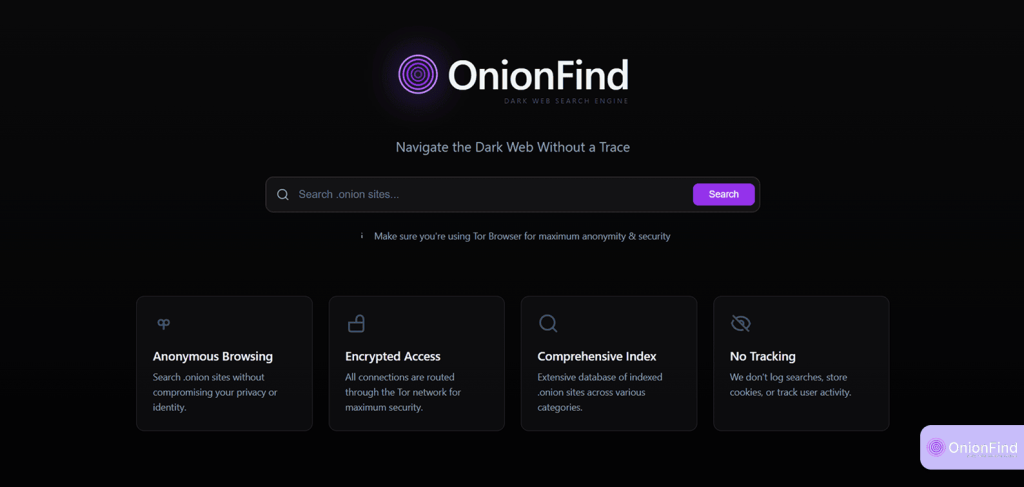
The interface is crisp and clear. It’s ideal when you definitely want dark web content without mixing in regular web stuff. Having it available on the surface web and Tor gives you flexibility depending on what you need and how much privacy you’re after.
But keep in mind, the results aren’t perfect. You’ll find a few inactive or duplicate links, as the site is not as strict as others when it comes to verification. Yet, it’s handy for surfing active .onion services without compromising your privacy.
2. OnionWiki

Pros
- Helps users discover hidden services
- No account or signup required
Cons
- Many links may be outdated or inactive
OnionWiki is a simple inventory, just rows of .onion services without fancy or frill search features. Think of OnionWiki as a curated collection instead of a massive database. It’s more like where newbies begin their dark web journey, especially if they want something direct and hassle-free.
This alternative provides you with a good number of well-known Tor resources in a neat category. Since it has no search function, you must scroll and browse the lists manually. This simplicity is a lifesaver for newbies; no complicated syntax.
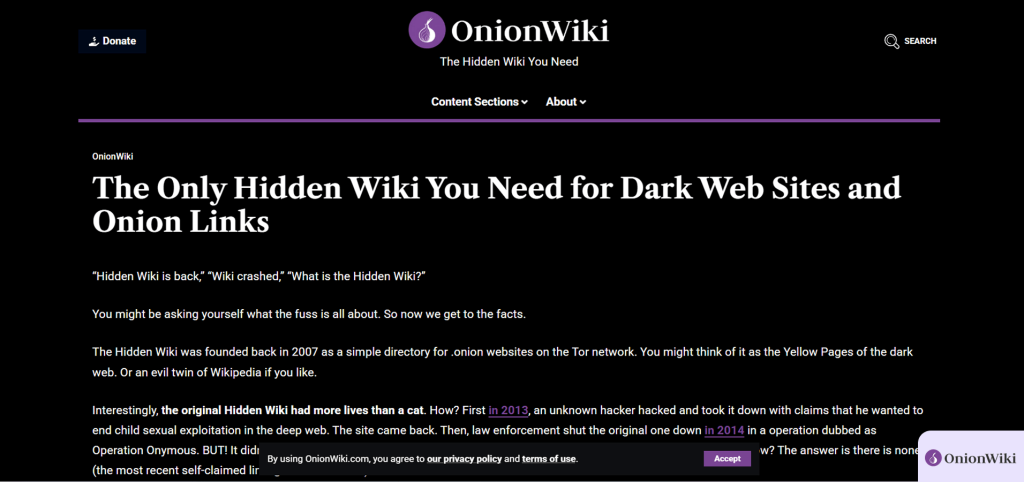
OnionWiki doesn’t track you and promises to check links before posting. But admins are pretty hands-off; they add or remove links whenever they feel like it, usually without telling users. So, if you want a barebones approach, OnionWiki delivers. New users usually love it because the layout isn’t overwhelming. Just browse, scan descriptions, and click around.
But keep your guard up. The directory carries a mix of risky and useful resources; you’d sometimes find questionable or illicit content. Even though the platform vets the links, it’s not bulletproof. So, always double-check everything before diving in.
3. DuckDuckGo
Pros
- Strong privacy; no user tracking or profiling
- Clean, simple search interface
Cons
- Less effective for very recent or niche content
DuckDuckGo is a search engine 100% indulged in privacy. At the same time, it comes with a .onion section that can reach Tor. Why is DuckDuckGo special?
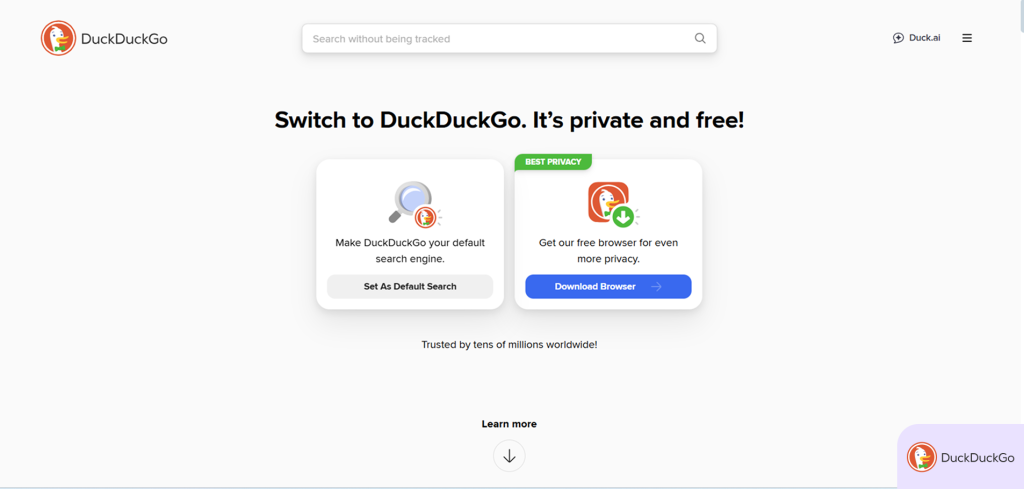
This makes DuckDuckGo unique; it works on both the surface and dark web. While it’s primarily known for surface web privacy, it also connects users to .onion content through Tor. It does not store personal credentials nor track your searches. It doesn’t even create a profile around your details. For this, security experts worldwide deem it credible.
Using DuckDuckGo is easy, for beginners in particular. Whether or not you’ve used the surface web version, you won’t struggle with the interface. The only difference is that the .onion version routes everything through Tor. The platform is convenient in terms of handling both surface and dark web content, so you don’t need to switch between tools.
4. OnionLand

Pros
- Simple interface for dark web search
- Helps discover hidden services quickly
Cons
- No guarantee of safety from scams
OnionLand does double duty as a dark web search engine and a deep web portal, so you get everything in one spot. It’s a nice setup when you know what you want or want to just poke around.
The real special attribute about OnionLand is how clean and user-friendly the design is. You can jump into numerous Hidden Wiki onion links without getting lost in confusing menus or endless lists. Thanks to “Categories,” everything is organized, so you don’t scroll blindly. Just select a topic and let the digging begin.
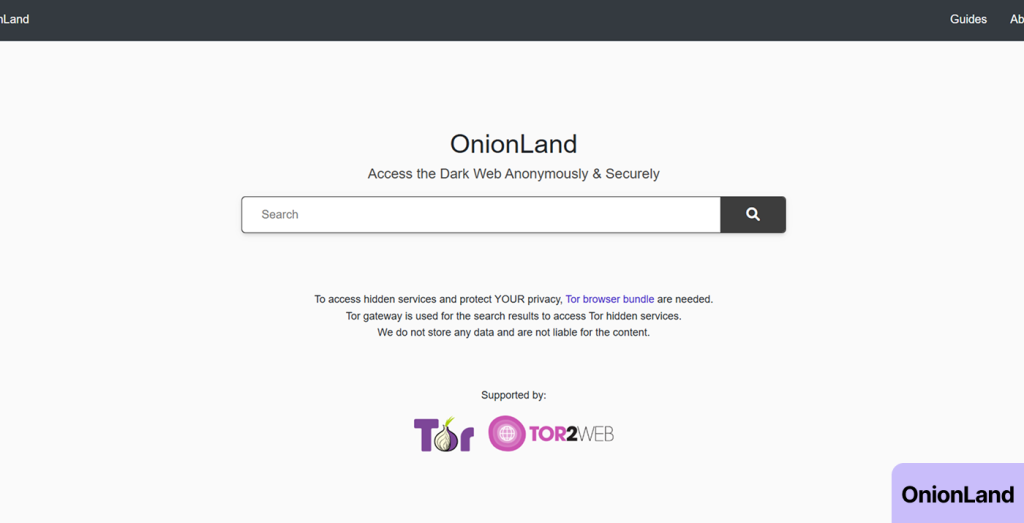
Plus, OnionLand loads fast, even when Tor’s connection feels like molasses. The team stays on top of updates, so you aren’t constantly running into dead links or ancient sites that vanished months ago.
Why bother using it? Sometimes, you don’t know what to browse for. With OnionLand, you just have to go through the listings arranged under different categories. You see different types of resources, dip into a few, and maybe stumble onto something unexpected.
Search and directory functions combined give you flexibility. When you have a target in mind, use search. If not, just browse.
5. Torch

Pros
- One of the oldest .onion search engines
- Fast indexing of hidden services
Cons
- Can surface illegal or harmful sites
Torch is very old in space, but at the same time, it is an option for going through the dark web, and it is reliable. Many call it the “Google of the dark web” because it indexes a huge number of .onion sites.
Torch is just one of several powerful dark web search engines. Our dedicated guide to the best dark web search engines compares tools like Onionfind, Torch, Torgol, Haystack, and Ahmia side by side.

The privacy features really set Torch apart. It doesn’t track your queries, stores zero user data, and shows no ads. This minimizes your exposure to malicious content and makes Torch a trusted go-to alternative to Hidden Wiki.
Torch indexes thousands of .onion destinations to provide you with a massive catalog of dark web websites. The results page loads quickly, and the interface remains uncluttered. Torch’s delivery is fast and ad-free. Even so, it carries a policy that does not allow it to track whatever you search; everything is 100% private.
The results you get from Torch follow whatever you search for. So, it can show dangerous destinations too. Make sure to verify the links before clicking, and DO NOT assume a search result is safe simply because Torch indexed it.
6. Torgol
Pros
- Lightweight search engine for .onion sites
- Simple interface for quick navigation
Cons
- Weak filtering of unsafe or scam sites
Torgol delivers when it comes to speed and privacy. It has a sleek display, a zero-logging policy, and a good volume of frequently updated index of .onion URLs.
Independent tests suggest Torgol actually outperforms Torch in link freshness and database size. Torgol continuously refreshes and revamps the sites it indexes, and so it reduces the number of dead links it houses.
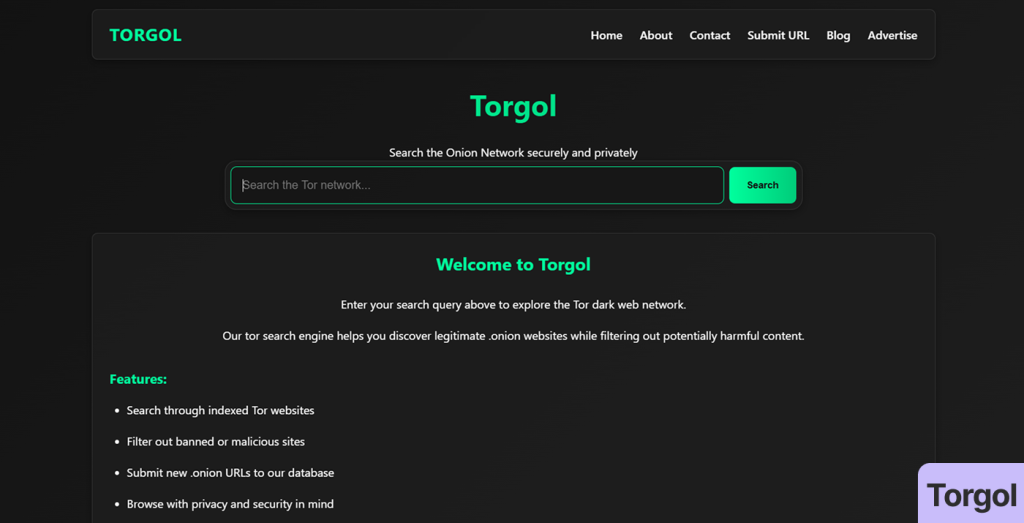
Also, the fact that the engine does not store any of your activities is brilliant. Torgol does not even store your data or your search records. Your privacy stays intact from start to finish.
Torgol works great when you’re tired of clicking dead, inactive links. The minimal dead links mean you spend less time frustrated and more time actually finding what you need. The massive .onion index covers content that other search engines miss. What’s more! The interface loads fast even on the slow connection speed of Tor.
7. Haystack

Pros
- Helps discover hidden services quickly
- No user tracking or personal data collection
Cons
- Search accuracy is inconsistent
Haystack targets power users who need advanced search capabilities. Its massive database of indexed dark web content rivals Torch and even goes further with powerful filtering tools.
The database is enormous, Haystack indexes millions of .onion pages, making it one of the most comprehensive dark web search engines available. The basic version works perfectly fine for free.
Haystack includes advanced features that cybersecurity professionals and researchers can use when they subscribe to a paid plan. The tools include deeper search capabilities, advanced filtering options, as well as priority indexing.
The website beats the competition when it comes to locating rare content that other engines miss. With the filtering tools, you can narrow down results precisely and save time. For researchers and experts in the cybersecurity space, the option that lets you pay money allows you to do thorough investigations. And for casual users, the free version is great too.
The interface of Haystack is not as simple as Torch or OnionFind’s. If you are just using it for the first time, the plenty of options and links in front of you can overwhelm you. Apart from that, Haystack is very powerful once you figure out how it works.
8. Ahmia
Pros
- Clean and simple search interface
- Focuses on safer .onion discovery
Cons
- Still misses many active onion sites
Ahmia comes with a different vibe compared to the other onion indexes. It does not index every link and piece of content. Instead, it actively fishes out illegal materials as well as sites flooded with malware.
One of Ahmia’s biggest advantages is that you can access Ahmia through the surface web. However, you’ll need Tor to get the actual .onion results. This makes it simple for new users and researchers to use it.

The mission of Ahmia is to bring the dark web closer to users with good intentions and, at the same time, keep them safe. The team manually goes through sites and adopts automated tools to fish out and take away dangerous materials.
The malware-free indexed results can guarantee, to an extent, that even if you accidentally click on a link, it won’t easily infect your device. Focusing strongly on legality and the safety of users are additional reason Ahmia is different from other unmoderated platforms.
Ahmia boosts your peace of mind. Without a doubt, the filtering doesn’t catch everything, but it greatly reduces the chances of clicking risky links. Other unmoderated platforms can’t beat this.
9. Keybase

Pros
- Strong identity verification via social proofs
- Supports teams, chats, and secure file storage
Cons
- Requires setup of identity proofs for full trust features
Keybase flips the script. It’s not a search engine or a directory. It’s a secure communication platform. Available on both the surface web and the dark web, Keybase gives you a way to prove your identity using cryptographic keys. None of your personal information leaks in this case. It even encrypts chat and files while sharing. In other words, conversations here are private.
The .onion version works exactly like the clearnet version, but everything runs through Tor for an extra layer of privacy. Its identity verification tools help you confirm people’s identities; and that’s really important in places where anonymity is the norm.
Keybase is mainly for communication. So, you won’t use it to find .onion sites, but once you connect with people or communities, it delivers.
What is the Best Hidden Wiki Alternative?

Since Hidden Wiki mirrors keep shutting down, reliable alternatives usher in safe and efficient entry to the dark web. Now, which alternative should you use?
The answer all depends on your preference. What do you want?
For full and detailed searches of all sources on the dark web, look no further than either OnionFind or Torch (or Torgol to an extent), as both search engines provide you with extensive indexing of .onion websites, they’re both updated frequently, and they both do not track your searches.
OnionFind has developed credibility within a not-so-extensive time frame; on the other hand, Torch and Torgol have been employing advanced technology, which are capable of indexing deeper into the dark web and providing you with links that have recently been created.
No matter your choice, you need a trusted source to surf the dark web. Ahmia is the safest when it comes to accessing content on the dark web. It provides filtering of all types of content from illegal websites and those infected with malware. This is extremely helpful for those researchers, journalists, and people who are looking to research and safely explore the dark web.
OnionLinks is a curated directory and has over 100 active and functional onion sites. Having a curated directory means that the focus is on quality instead of quantity; in addition, the links will be functional as well, and any links that lead to dangerous destinations are removed frequently.
Dark Fail is a specialized link index that specifically caters to dark web marketplaces and has only links to marketplace sites listed in its database. Dark Fail is also updated frequently to remove scam listings and resources that are no longer functional.
Example: You are probably familiar with HiddenWiki.com.
The Home page shows you a larger collection of links compared to what’s on other hidden wiki mirrors. Use this as a head start for exploring the many other options available. The best way to approach the dark web is to use many different sources.
The truth is, you cannot depend on one directory or search platform. Links go down, sites are hacked, and scams can slip through any of those directories or search engines.
So, it’s best you keep a collection of various directories and then verify the links across all of them. If one .onion address appears identically in three different credible sources, it is likely legit. Otherwise, be very cautious before clicking on it.
How to Safely Use Hidden Wiki Alternatives

Finding good directories or search engines is only the first step. To stay safe is another. Work with these pro tips to be on the safe side:
- Always use the Tor Browser: Don’t open .onion sites in regular browsers like Chrome or Safari, as they aren’t designed for it and won’t protect your privacy. Download the official Tor Browser from the Tor Project and avoid unofficial versions, which may contain malware.
- Use a VPN before Tor for extra privacy: It can hide Tor usage from your ISP and encrypt traffic before it enters the Tor network. Choose a trusted VPN with a strict no-logs policy and strong encryption, and avoid free VPNs since they often monetize user data.
- Always verify links from multiple sources: Don’t trust the first link you find. Cross-check it through reputable directories and review community feedback on platforms like Tenebris or The Hub before visiting a site. A trusted forum can also help you identify phishing clones, dead links, and recently updated onion addresses before you visit a site. For a deeper dive into identifying malicious sites, check our guide on spotting phishing sites on the dark web, covering red flags like URL inconsistencies, login page clones, and social engineering tactics.
- Never share personal details: Avoid revealing your real name, email, or location. Use a separate email for dark web activity that has no connection to your real identity.
- Disable JavaScript and avoid downloads when possible: Unknown listings can use JavaScript to collect system information, so disable it whenever you can. Also, avoid downloading files unless absolutely necessary, as malware risks are much higher on the dark web.
- Be cautious with cryptocurrency: If you make transactions, use a separate wallet for dark web activity and avoid linking it to ID-verified accounts or exchanges. Research escrow services carefully, as scammers often target careless users, and lost funds are rarely recoverable.
- Stay informed about new threats: As technology evolves, so does the dark web. Familiar threats can quickly become more dangerous, so follow cybersecurity experts and stay updated on scams, hackers, and privacy tools. The latest knowledge can make all the difference.
Conclusion
Hidden Wiki once drew massive attention as a go-to directory for exploring dark web onion sites. However, frequent downtime, outdated listings, and security gaps have pushed many users to look elsewhere.
Today, several strong alternatives exist, including Torch, Torgol, OnionLand, and more. These platforms offer larger, regularly updated databases and often filter out malicious content to improve user safety.
A simple rule: don’t rely on a single source. Explore multiple trusted sources, bookmark them, and cross-check information whenever possible. For added safety, always use the Tor Browser along with a VPN.
The dark web offers privacy benefits, but it also comes with serious risks. Staying safe depends on the tools you use and how carefully you use them. If you found this guide helpful or have suggestions, feel free to share your thoughts.
FAQs
Hidden Wiki is a simple database that provides .onion links for people to easily find what they’re looking for on the dark web. It often crashes and can have old, bad links. Alternatives like Torch, Ahmia, and Torgol usually have fresher lists, better updates, and stronger safety measures.
Most countries don’t restrict Hidden Wiki alternatives or even dark web access itself, as long as it isn’t used for illegal activities. However, engaging in unlawful actions can lead to serious legal consequences that are difficult to escape.
A lot of folks point to Ahmia in this regard because it takes away bad sites early, before giving you any results. Also, automated tools and humans manually review every listing you see here. Remember, no one is 100% safe. So, it’s advisable if you use it together with a Tor Browser, VPN, and turned-off JavaScript.
Use Tor Browser. Regular browsers can’t reach .onion addresses, and aren’t anonymous. Download Tor Browser from its official site. Never grab random versions for any reason, unless you want full-fledged malware. Open it, type the .onion URL into the bar, and Tor handles the rest. Want extra protection? Run a VPN first to hide Tor usage from your internet provider.
Not 100% percent. Dead links, phishing, and scam sites can mix up in even top-notch directories. Also, cross-check links on more than one source before proceeding. Also, use PGP signatures to confirm legit links.