-
Polish authorities caught a man they believe has been helping the Phobos ransomware gang.
-
The search at his house uncovered many devices containing credit card numbers, server access data and stolen credentials.
-
His arrest is part of Operation Aether that puts together huge amounts of information about the Phobos group and all those working with them.
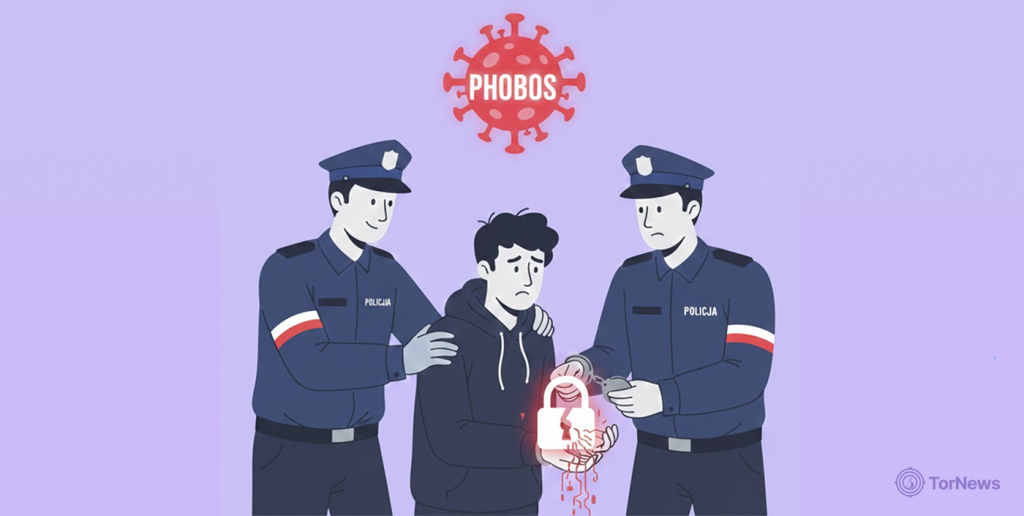
Polish authorities just nabbed a man they suspect is in cahoots with the Phobos ransomware crew. The Central Bureau of Cybercrime Control (CBZC), Poland’s cyber-swat team, arrested him in Małopolska. They teamed up with units from Katowice and Kielce to pull it off.
Computers with Stolen Data Discovered and Seized
When searching the suspect’s home, the officers found files containing credentials, passwords, and credit card numbers. Inside the files, there were also server IP addresses that could unlock access to computer systems.
Prosecutors from Gliwice are now supervising the case. There’s evidence suggesting the suspect was planning to help launch ransomware attacks. Police found out he used encrypted messaging apps to talk straight to the Phobos cybercrime group.
The CBZC said on Tuesday that someone can use the data to break into electronic security systems. The agency said the 47-year-old suspect was in touch with the Phobos group, which has a track record of carrying out ransomware attacks.
He now has charges of hacking tool possession and distribution hanging over his head based on what the law in Poland says. And if they find him guilty, he sure might spend up to five years in prison.
Operation Aether Dismantles Phobos Ranks
Phobos isn’t new to the game. It’s been hustling ransomware-as-a-service for a while now; they’re the successor to Crysis, an old ransomware crew. They have not been flaunting themselves like other groups. But they’re still very active and one of the biggest headaches in the cybercrime world.
Between May and November 2024, Phobos accounted for 11% of all submissions to the ID Ransomware service. The U.S. Justice Department linked the gang to over 1,000 breached entities globally. This group has raked in over $16 million in ransom from victims.
A Coordinated International Effort
Operation Aether targets everyone involved with Phobos. This includes backend operators and the affiliates who break into networks and encrypt files. The operation has recorded a lot of success in recent years.
According to a DoJ report, they extradited Evgenii Ptitsyn, a supposed Phobos administrator, from South Korea to face judgment in the US in November 2024. Then, last February, police raided and seized 27 servers in Thailand. They also arrested two suspects in Phuket who had connections with Phobos.
Further, Italian police arrested a big player in Phobos during 2023. These arrests are slowly taking apart the criminal group running this ransomware. Last February, Europol announced that this whole thing was a success, thanks to the cooperation of law enforcement in 14 countries.
Some focused on Phobos, while others targeted the related 8Base ransomware group. This coordinated approach has also led to high-profile arrests outside the ransomware space, including Dutch prosecutors’ charging of a 21-year-old ‘kingpin’ for running dark web markets, proving that international cooperation works across all forms of cybercrime. Crucially, the operation helped warn more than 400 companies about imminent attacks.
Victims also got some good news last July. Japanese police dropped a free decryptor for both Phobos and 8Base ransomware. That means people who got hit can now recover their files without paying a dime to criminals.
What This Arrest Means for the Fight Against Ransomware
This arrest sends a loud warning to hackers everywhere: law enforcement isn’t working in silos anymore. Teams from different countries are actually working together, and they’re a lot sharper than before.
This coordinated approach is paying off globally. Just weeks ago, authorities in Spain arrested a teen hacker accused of selling 64 million citizens’ data on the dark web, proving that age is no shield from international justice and that law enforcement is increasingly skilled at tracking criminals across borders.
The suspect thought using encrypted messaging apps would hide his activities, but that plan didn’t work out. Turns out staying anonymous is not as easy as he thought.
The Phobos group has taken some serious hits recently. Between the Thailand server seizures and this latest arrest, their operation is struggling. When you integrate law enforcement crack downs with free decryptor tools, victims get a real shot at recovery.
This whole case is a wake-up call for the rest of us regular folks. The stolen credentials on the suspect’s devices could’ve been yours or mine. So we all should be careful with our passwords; make strong, unique ones and join that with two-factor authentication.
These measures aren’t optional, rather they’re essential. Ransomware is still out there causing trouble, but wins like this actually give everyone hope.
