-
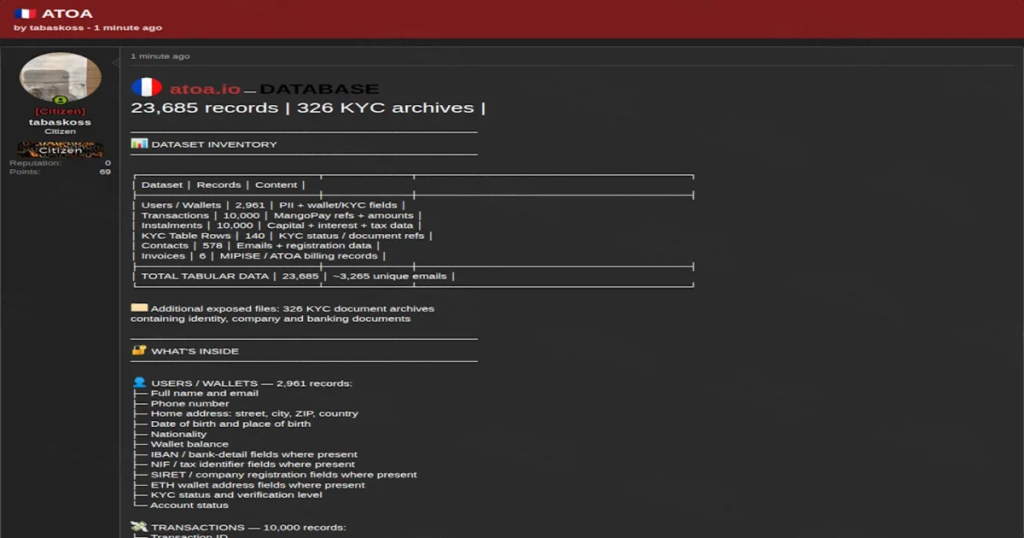
A dark web forum post claims ATOA suffered a data exposure involving 23,685 user records and 326 KYC document archives containing identity, wallet, transaction, and banking information.
-
The alleged KYC document leak poses serious identity theft risks, as passport scans and government IDs can help criminals bypass verification systems and open fraudulent accounts.
-
ATOA users should monitor financial accounts for unauthorized activity, enable multi-factor authentication, and watch for phishing attempts that may use the stolen personal information.
A dark web forum post alleges a database leak involving the fintech platform ATOA with regards to an alleged database leak. The purported database consists of a total of 23,685 records and 326 sets of KYC document archives.
The exposed dataset allegedly consists of user profiles, wallets, transaction history, identity, billing, and bank-related information. Security researchers have warned that data such as this will provide threat actors the opportunity to conduct fraud, identity theft and perform some really sophisticated phishing attacks. The first indication of an alleged breach came from underground forums, where threat actors offered the data for sale and distribution.
At the time of this writing, ATOA has not publicly confirmed or denied the alleged breach. Also, there is still no independent confirmation of the claims from security researchers, so some experts warn the public to treat claims as an allegation until further investigations can confirm the leaked dataset.
Exposed KYC Documents Pose Serious Identity Theft Risk
The alleged inclusion of 326 KYC document archives raises the severity of this breach significantly. Know Your Customer documents typically contain passport scans, driver’s license images, utility bills, and other government-issued identification. These documents provide cybercriminals with everything they need to commit identity fraud.
KYC archives hold particular value on underground markets because they enable attackers to bypass verification systems. Many financial platforms rely on document uploads for account creation and transaction approvals.
Criminals are also using AI to create fake documents. Deepfake tools sold online claim to bypass bank and crypto KYC checks, showing that KYC systems face threats from both stolen data and synthetic forgeries.
These types of documents can provide a cybercriminal with all of the information necessary to commit identity fraud, they can open new accounts, access existing ones, or launder money through legitimate financial services.
The combination of structured data (23,685 records) and unstructured document archives (326 files) creates a complete victim profile. Attackers can pair the tabular information with the corresponding identity documents for each affected user. This pairing makes fraud schemes much harder to detect and prevent.
Fintech companies collect significant amounts of personal information from customers at the time of on-boarding. This would include, among other things: first and last name; mailing address; date of birth; national identification number; and possibly biometric data.
If any of the large volume of personal data leaks, from the KYC document archives, the individual may be subject to many years of identity theft and financial fraud monitoring.
User and Transaction Data Enables Financial Fraud
The reportedly leaked records consist of user profile data, information pertaining to wallets, and transaction histories. Criminals are able to use this data to learn about a victim’s spending patterns and behaviors associated with their accounts, which then enables them to conduct convincing acts of fraud without easy discovery.
The transaction data specifies the volume of movement of money from one account to another, when the transfer occurs, and the recipient of the cash. With this intelligence, criminals can pick the optimum time to conduct their attacks to be more effective, they can use this intelligence to time their attacks for maximum impact. They might wait until a large balance appears before attempting a withdrawal or transfer.
Wallet and banking information allows attackers to attempt direct financial theft. Stored payment methods, linked bank accounts, and cryptocurrency wallet addresses all become targets. Immediate Criminals may try to drain funds or use the information for larger-scale financial crimes.
The alleged breach also affects ATOA’s business reputation and customer trust. Fintech companies operate on the promise of secure financial services. A data leak of this type erodes people’s confidence in the platform’s capacity to safeguard personal data.
ATOA Users Should Take Protective Measures
Individuals who use ATOA services should take several steps to protect themselves immediately. Users should monitor their bank accounts and credit reports for any unauthorized activity – they can place a fraud alert and credit freeze with top credit bureaus to create an additional layer of defense.
Customers should be aware of any phishing attempts related to ATOA or using their stolen personal information. Many criminals use the breached data to make their fraudulent communications as believable as possible; an email that includes the recipient’s name, address, or account information will look far more credible than a generic email that uses no identifying information.
Also, ATOA users need strong, unique passwords for every account, they should activate two-factor authentication everywhere possible and avoid reusing login credentials. Credential stuffing attacks exploit recycled passwords.
Watch for fake calls or texts claiming to be from ATOA, as scammers impersonate support teams. Always verify contact through official websites, not links or numbers in suspicious messages. Security researchers continue investigating this alleged breach. Stay alert until authorities confirm the full scope.
