-
New cyberextortion group Inception claims it broke into seven companies, including Cigna, PepsiCo, and AMD.
-
Research findings revealed that the group uses phone-based phishing schemes to trick employees into revealing company login details.
-
ReversingLabs found 21 illegally registered domains as evidence that Inception has targeted dozens of companies, not just the seven it named.
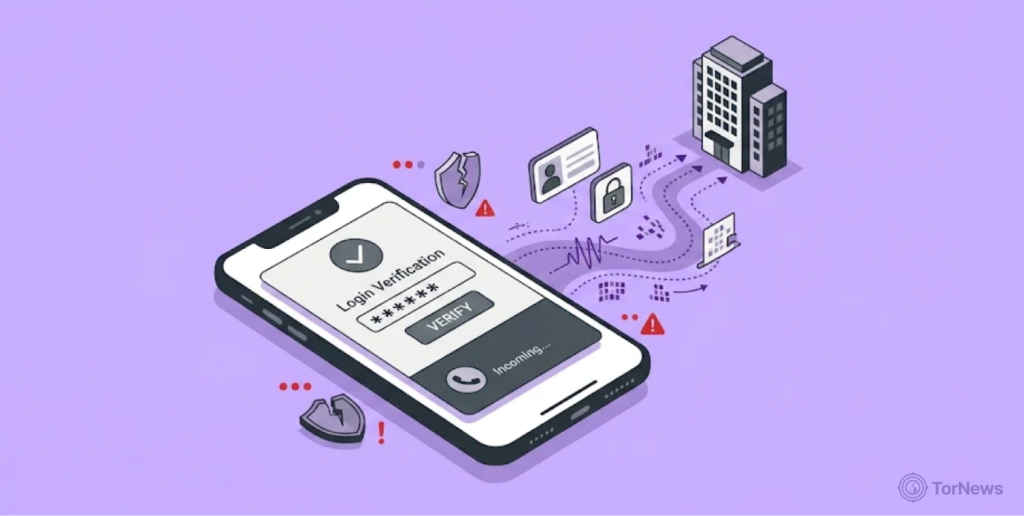
A new ransomware gang known as Inception is targeting major U.S. corporations. Instead of using phishing emails, Inception takes a more traditional route and calls its victims.
On November 23, cybersecurity firm ReversingLabs published its findings on the new activity. Several businesses, including AMD, PepsiCo, Cigna Healthcare, Paychex, Henry Schein, AutoZone, and Lucid Motors, have been listed on Inception’s leak site.
Please note that these names are only what Inception puts forward; nothing has been verified. What is more, the number of suspicious websites discovered suggests there could be a significantly greater number of victims than what’s on the group’s target list.
A Phone Call Replaces the Traditional Phishing Email
The attack has been ongoing since late October 2026. The principle behind the hack is quite straightforward. A caller makes contact with the employee, establishes trust with him or her and then asks the employee to open a web page that resembles the company’s authentic login page.
Such practice is known as “voice phishing” or simply “vishing”. It does not require any software vulnerability; it only requires someone who trusts the caller.
According to Okta’s own report, the callers pretend to be technical support and try to make employees reset a password and change the settings of their accounts. After that, the scammer guides the victim through the fake sign-in page that collects usernames and passwords. Moreover, it requests additional proof from the victim, such as a one-time code or login authentication alert.
It should be noted that this problem is not the result of some previously unknown flaw of Okta or NetIQ. The scammers simply deceive users into performing regular login procedures on a spoofed page.
Fake Legal Sites Mirror Corporate Login Pages to Look Legit
ReversingLabs discovered a set of websites mimicking legal and compliance portals. Their naming follows several patterns. There are those starting with “legal-” followed by the brand. Other portals include the suffix “-legal” after the main brand name. Some have “legaldept-” prefix, or end with “.legal.”
A name like that will sound realistic on a phone call. An employee will probably believe the legal department needs a quick review of documents. However, this site has a different purpose, which is to steal login information.
Ransomware groups have also adopted other tactics to pressure victims during extortion attempts. In a separate campaign, attackers used AI-generated legal reports to make their demands appear more credible and frighten targeted organisations into responding.
The phishing kit identifies which login authentication system is used by the target company. After that, it serves a relevant web page. Most of the confirmed phishing attempts used Okta. There were redirects to specific Okta addresses for AMD and PepsiCo. Lucid Motors’ phishing portal pointed to NetIQ and OpenText login pages.
The phishing site also filters visitors by certain criteria. Those who don’t fit the profile may be redirected to the company’s real website, making it harder for investigators. A scanning tool will see a website and pass it as safe.
The researchers also found some suspicious domains that redirect visitors to the legitimate company websites. That means that attackers may have been using this trick across several domains.
Researchers Uncover Dozens of Additional Targets
The researchers identified 21 domains, which they label as “confirmed,” as there was direct evidence of the phishing kit. They also identified an additional 41 domains which are highly likely to be tied to the campaign. Another four domains had medium confidence of being linked to the operation.
The importance of the distinction is noteworthy as confirmed domains presented the phishing kit itself. Other domains had similar naming, hosting, and registration that matched the campaign’s patterns. The gathered data suggest that the scale of the operation is much larger than it was claimed publicly by Inception.
Apart from the famous companies, the report mentioned many others, including Starbucks, Netflix, Reddit, Tesla, Adobe, Nintendo, Amazon, McDonald’s, and NBCUniversal.
In addition, companies from various fields are on the list, like Anthropic, Alaska Airlines, Delta, KFC, Ubisoft, Epic Games, and Wynn Resorts, among others. There are also companies related to the financial, healthcare, and other fields mentioned here.
Nevertheless, finding a name in the list does not guarantee a breach. It just means that the researchers connected a domain to the operation. The medium- confidence group is still weaker, as it has copycats for Activision Blizzard, Warner Bros, McDonald’s and Everpure Data.
Clues Tie the Sites Together
There are a few details connecting these domains. Most of the domains mainly belong to one registrar, NICENIC, and only some are from NameSilo, Spaceship, and Tucows. The registrations occur mostly at night, between 18:00 & 00:59 UTC. The highest activity occurs around 19:00.
The attackers quickly transfer the registered domains to Cloudflare. The researchers also detected more than 15 pairs of nameservers belonging to Cloudflare. The domains’ email settings also provide another hint. The analyzed domains do not support sending emails, meaning they were created especially for phone scams.
The timing also plays its part. Certain domains related to certain institutions were registered 3 to 20 days before their victims appeared on the leak folder. On November 8, for instance, the attackers registered the name of a domain similar to Henry Schein and reported the company as the victim on November 17. That gap strongly links the fake sites to the extortion campaign.
Who is Behind Inception?
It’s not clear who exactly is behind the cyber extortion group. A separate November 23 report from Okta linked the campaign to the threat actor it tracks as O-UNC-053. Okta claims that O-UNC-053 has been active since March 2026. Initially, researchers linked the first activity to ShinyHunters. Recently, the group seems to have adopted the name Inception.
Okta believes they must have changed their extortion partner. However, it’s still not certain whether the threat actor controls the Inception website or cooperates with some other group. A change of names does not necessarily imply a change of groups.
Both reports feature the same modus operandi: phone attacks, login credentials theft, and data extortion.
What Comes Next
Inception’s claim of hitting seven companies illustrates only a fraction of the reality. The additional domains indicate that there is likely a much bigger campaign in place. Nonetheless, the research needs to clarify whether any of the companies have actually suffered a breach.
However, at the moment, the evidence points to one obvious conclusion. A well-organized team is using phone calls to penetrate company login systems. So if someone unexpected asks you to change your password, you should take it as a red flag.
How Companies Can Protect Themselves
A phone call will bypass email filters. Hence, ReversingLabs provides some advice. Start by using login methods resilient to phishing attacks. Examples are security keys and passkeys. This will make sure that attackers can’t reuse stolen passwords and codes.
Secondly, educate employees to be wary of unexpected phone calls asking for immediate changes to their login credentials. The IT and legal departments must verify any suspicious requests using a trusted internal channel.
Also, pay attention to domain names that combine your brand name with terms such as “legal”.
Last but not least, review the network traffic and login activity. Check for unusual sign-in activity, strange approval requests, and sign-ins coming from unknown locations.
If the hackers succeed in getting in, terminate all ongoing sessions and change the compromised passwords.
