-
A hacker group that claims to be the Akatsuki Cyber Team has threatened to make public the passports and birth certificates of 120 Israeli citizens if Israel does not stop military operations in Gaza.
-
Dark Web Informer, a group that monitors Israeli internet activity for threats, received the threat from the Akatsuki Cyber Team shortly after it was posted to a dark web forum.
-
According to Cybersecurity experts, fake public-fearing cyber threats can perform as psychological warfare techniques and can create public panic when no actual breach has occurred.
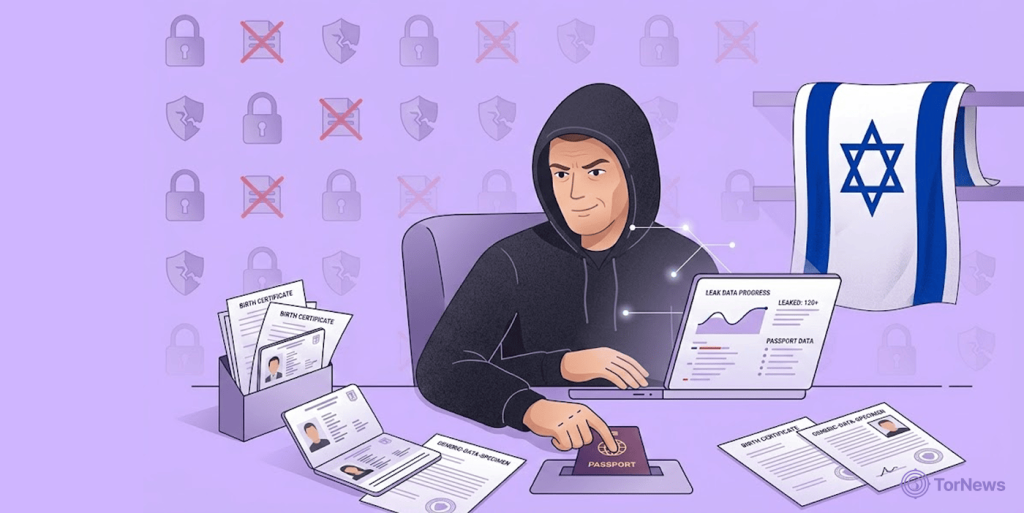
A hacking group, referred to as the “Akatsuki Cyber Team,” has threatened 120 individuals from Israel by announcing they had hacked their personal documents (passports and birth certificates) and have the data in their possession.
The Akatsuki Cyber Team announced this information through a website monitored by Dark Web Informer, a cybersecurity watchdog tracking the “X” (formerly Twitter) forum, and shared it with the public. This announcement had no time limit, thus raising concern among cybersecurity professionals.
Political Motivation to Fuel Cyber Threat
Thanks to the #free_palestine hashtag, there is no doubt that the drive of this group is political. Regarding recent developments in the Israeli-Palestinian conflict, there has been an increase in hacktivism as a form of civil disobedience through cyber attacks.
Hackers globally have chosen sides in this matter and have targeted government websites and critical infrastructures, and have now begun going after private records of individuals who have nothing to do with the conflict.
Currently, no independent sources have verified the documents, and the group itself has provided no confirmation. However, the simple threat from this group raises significant concerns for cybersecurity experts because of how quickly civilian data can become a weapon when political conflict overflows into cyberspace.
Dark Web Informer Raises the Alarm
Dark Web Informer operates largely through X, providing timely alerts about breaches, exposed credentials, and criminal activity on dark web forums and encrypted networks. Security researchers and journalists often cite data published by Dark Web Informer as an early warning indicator. Dark Web Informer has developed a reputation for being an independent alarm system for new cyber attacks or data breaches.
The dark web, a part of the internet inaccessible to standard browsers and unindexed by traditional search engines, serves as a marketplace for stolen data, hacking software, and illegal services.
This post is a hybrid of alleged cyber extortion, consisting of elements of ransomware and an ideological statement. Security analysts refer to this hybridization as a significant element of conflict-based hacktivism, a style of hack that has become increasingly common since the escalation in October 2023.
A Rising Pattern of Conflict-Fueled Cybercrime
Cybersecurity specialists have identified many examples of hacktivist operations in both the Israeli and Palestinian conflicts that started escalating in mid-October 2023. Allegations include a number of hacktivist-directed large-scale distributed denial of service attacks, defacements of many government websites, and the theft/posting of private records on various individuals as well. Increasingly, these attacks have inflicted collateral damage to civilians, and hackers are using personal information as leverage to affect political change with their targets.
As of the time this writing is being made, Israeli officials have not responded to allegations surrounding an alleged security breach. There remains significant uncertainty as to whether or not these hackers possess the documents they claim contain evidence of wrongdoing or whether this statement is part of a larger disinformation strategy.
With the growing number of purposeful cyberattacks occurring in response to conflict, the protection of personal information has become far greater than simply a corporate security issue; it has become an issue at the front line of conflict for the millions of everyday people caught in between.
