-
A threat actor claims to have stolen over 50GB of data from Bolivian healthcare provider Clínica Foianini.
-
The database allegedly contains patient records, medical histories, test results, as well as medical images and other personal details.
-
Public sources confirm that Clínica Foianini uses digital systems to manage health records, but there’s no official confirmation of a breach or proof that the stolen data is valid.
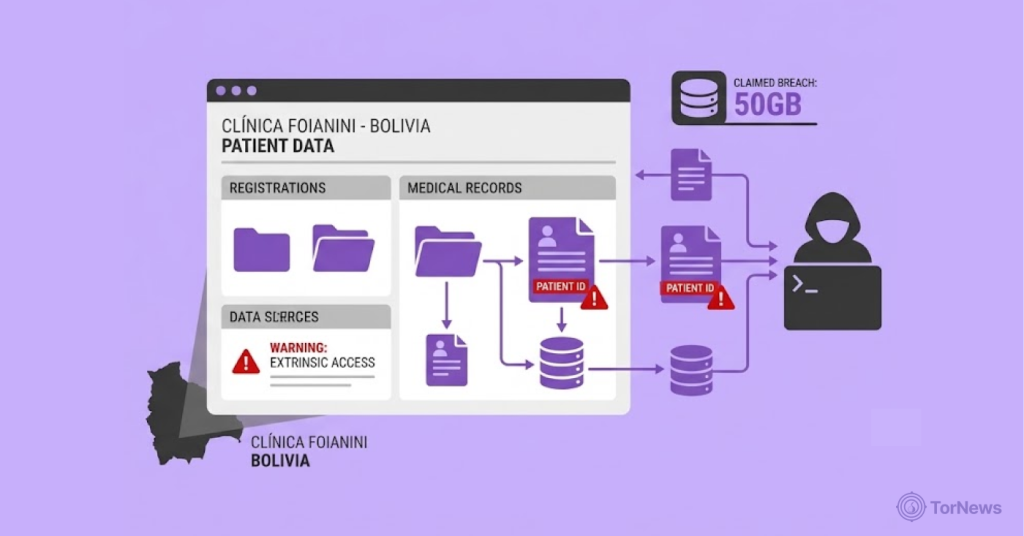
A user on a cybercrime forum says they’ve hacked Clínica Foianini, a private healthcare provider in Bolivia, and grabbed more than 50GB of data. They claim the haul includes electronic medical records, patient histories, diagnostic tests, lab results, medical images, and personal details.
However, right now, there’s no independent confirmation of any cyberattack at Clínica Foianini. The post alone doesn’t prove anyone actually breached the clinic’s systems or that the files really belong to its patients.
What the Threat Actor Claims
The underground listing says the files contain patient histories and electronic health records, according to threat intelligence reports. The listing also mentions diagnostic studies, lab results, medical images, and personal information. But the 50GB figure comes from the threat actor. No independent source has checked the size or contents of the alleged dataset.
The listing also gives no clear date for the alleged attack. It doesn’t say how the actor actually got in. There’s no sample to back up the claims or prove whether these files came from a live clinic system, an old backup, or somewhere else entirely.
Hackers usually reuse data from old dumps or blend data from various sources. They even stretch the truth about the size of the data dump just to make it appear more attractive to potential buyers. So, a listing alone cannot prove anything.
Foianini Uses Digital Medical Records
Clínica Foianini does store large amounts of health data in digital systems. The clinic introduced a unified electronic medical record system in 2020 that brings all medical info, including consultations, emergency care, hospital stays, lab work, imaging, and medical procedures, on one platform.
Clínica Foianini added that the digital system connects with pharmacy, laboratory, imaging, and accounting platforms. Staff with permission can pull up patient details instantly in real time.
GeneXus, the tech company behind Foianini’s digital medical record system, also highlights in its case study that the platform lets staff quickly pull up patient information and helps with day-to-day clinical work. This shows how damaging a real data breach could be. But it doesn’t prove that one actually happened.
Patients can Access Health Information Online
Foianini offers several online services to patients. The clinic’s website says patients can check their lab and imaging results online, on the app, or just by scanning a QR code from their service vouchers. If you’re using their Android app, you can book appointments, look up prescriptions, see lab results, and access medical images. Everything’s right there.
Also, the clinic claims that it protects the privacy of its patients. On the patient information page of the clinic, it claims that it doesn’t share information regarding its individual patients with any third party.
Online access does not prove that attackers reached these systems. It only shows that the clinic handles sensitive health information through digital services.
No Public Confirmation so Far
A review of any publicly available reports reveals no independent account that correlates to the latest claim. There have been no reports of a ransomware attack or of a data breach at Clínica Foianini that match the recent claim of 50GB of stolen information.
The publicly available website of Clínica Foianini is still active and still offers information on the clinic’s appointments, emergency service, lab services, imaging, etc. Having an active website does not mean that a breach did not occur. Attackers can steal data without taking a public site offline.
Still, the available evidence does not support calling this a confirmed hack. And no verified sample to validate that the alleged files actually came from Clínica Foianini.
Similar claims have surfaced in Bolivia before, including one involving alleged access to a government GitLab server. In that case, a threat actor also claimed to have access to sensitive systems, showing why underground listings should be treated cautiously until independent evidence confirms the claim.
The lack of a public statement also proves little. A healthcare provider may need time to investigate a claim before it comments. Silence is not proof of either a breach or a denial.
What could Happen If the Data is Real?
Medical records can cause lasting harm when criminals obtain them. Names, identity details, medical histories, test results, and scans could help criminals target patients with scams. Unlike a password, a diagnosis or medical history cannot simply be changed. Criminals could use real medical details in fake emails, calls, or messages. A message that mentions a genuine test or appointment may look more convincing.
The data could also expose patients to blackmail or medical identity theft. Those risks depend on the information in the files and whether criminals can link it to real people. At this stage, these outcomes remain possible risks, not confirmed effects of this claim.
Since no public evidence has linked the alleged data to an intrusion into the clinic’s production systems, this incident remains merely what it is: an underground listing. Until further evidence surfaces to establish the data’s source, confirm that the records are genuine, and link the theft to a real intrusion, treat this claim with a grain of salt.
