-
Internet criminals attack Indian academic sectors and research groups with an average of 8,487 hits every week, almost twice the global average.
-
Ransomware breaches class sessions and exams, while bad actors sell personal records, transcripts, as well as forged certificates on the dark web.
-
Artificial intelligence now fuels sophisticated attacks that appear like exam portals and payment gateways to hijack credentials.
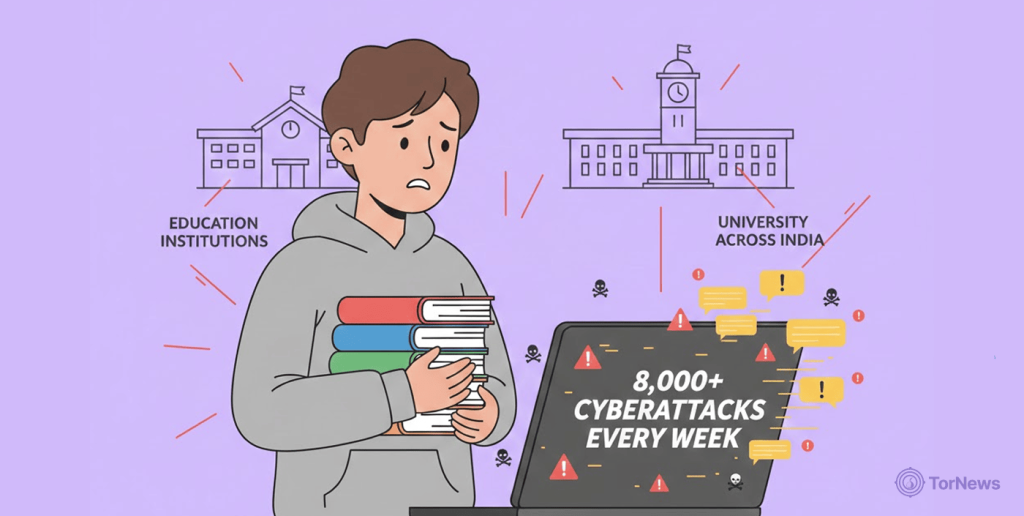
Web thieves have shifted their interest to education, and Indian institutions face the consequences of this assault. Students, administrators, and faculty now surf a digital minefield where their credentials become monetized on the dark web.
Check Point Research (CPR) just posted alarming statistics. The academic space is now among the most vulnerable sectors in the world. Indian institutions experience attacks at nearly twice the global rate. This creates a crisis that extends far beyond simple IT problems.
Attacks Hit Indian Education Sector Twice as Hard
Education and research groups in India face an average of 8,487 cyber attacks weekly in the last six months. The report matched this up to the worldwide average of 4,368 hits per group. That’s almost double the attacks.
CPR also examined other sectors. Indian organizations across all industries experience about 3,278 weekly attacks. This still exceeds the global benchmark of 1,934. But education takes the hardest hit by far.
The report highlighted several factors that make schools and universities prime targets. Hybrid learning models expanded the attack surface. Connected campuses increase vulnerabilities.
Students and staff broadly use personal gadgets with different security standards. These same vulnerabilities exist across borders, which is why hackers were most likely able to steal and list for sale the data of 58 million Indonesian students, demonstrating that the education sector’s weaknesses are being exploited globally. The threshold on budgets forces a lot of institutions to run without dedicated internet security teams. As such, attackers take advantage.
Ransomware Shuts Down Exams and Classes
Cyberattacks create consequences that reach beyond technical disruptions. Ransomware incidents disrupt exams and delay critical assessments. Some institutions go offline for weeks at a time. Students cannot access coursework. Faculty cannot grade assignments. Administrators scramble to maintain operations.
A 2023 Sophos report documented the financial toll. Median ransomware payments reached $6.6 million for lower education institutions. Higher education institutions paid $4.4 million on average. Despite these massive costs, recovery remains painfully slow. Only 30% of victims completely got their systems running within seven days.
Hackers go beyond encryption and ransom billings. Data breaches nurture a thriving marketplace on the dark web. Cyber thieves sell personal records, transcripts, as well as forged certificates to the highest bidder, erecting long-term risks for institutions and students alike.
The report cited an extreme case. Lincoln College in Illinois ran for 157 years before a ransomware attack forcefully shut it down permanently. The long-lived institution couldn’t recover from the monetary and operational crash.
AI Rolls Out Thousands of Fake Domains
Artificial intelligence intensifies the threat landscape. CPR recorded 18,000 new education-related domains in July 2025 alone. The team flagged one in every 57 domains as malicious. Many of these emerged from AI-generated content designed to mimic legitimate exam portals or fee-payment systems.
Attackers deploy AI for multiple purposes. Deepfake phishing campaigns fool even cautious users. Large-scale credential theft operations harvest login information across hundreds of institutions.
The attacks that use new malware will speedily exploit the weaknesses of a given system right away after the discovery date of the vulnerability – this attack cycle has gotten faster than traditional forms of defense against these attacks can provide.
Sundar Balasubramanian, Managing Director of Check Point Software Technologies – India & South Asia, has provided a strong warning ….i.e., “The education sector in India has seen an overwhelming increase in the number of attacks that use Artificial Intelligence to make them successful at stealing confidential information and disrupting education/learning to millions of students.”
He also encouraged schools to use a “prevention-first” approach to combat such attacks, including Artificial Intelligence-driven defence mechanisms (anti-virus), hybrid mesh security models, cloud-enabled protection, and threat intelligence.
Expert security specialists have made a number of recommendations that can be addressed immediately. Institutions should adopt multi-factor authentication on every system, roll out phishing awareness training, and implement routine patches for systems to eliminate known vulnerabilities.
The urgency of these measures is underscored by the wave of fake ID extortion scams recently sweeping India, a direct result of massive data leaks that have armed criminals with the personal information needed to terrorize victims and drain their finances.
