-
DeepMind researchers at Google just released the first public systematic framework that exposes how bad actors engineer malicious web materials to manipulate, deceive, and take advantage of autonomous AI agents.
-
Attackers can sneak instructions into invisible codes on a webpage, poison the memory systems of the AI, and coerce agents into harvesting user data, all in a stealth mode.
-
The researchers flag a critical concern with regards to accountability; when a manipulated AI agent commits a money-related crime, no legal system currently decides who bears the responsibility.
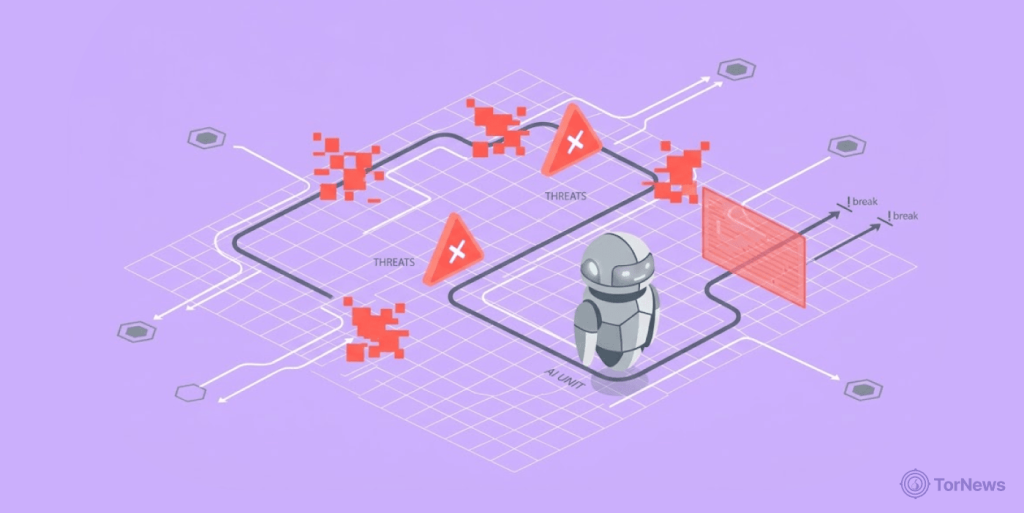
AI agents that browse the web are now targets to an advanced new category of attacks. “AI Agent Traps” is what the DeepMind Researchers at Google call it.
It is adversarial content that attackers intentionally hide in digital resources and websites to compromise and exploit any AI system that interacts with it.
Researchers Hint at Six Ways Bad Actors can Harness AI Agents
Matija Franklin and the research team developed a six-class framework covering the main ways attackers exploit web-surfing AI agents.
They include: content injection traps, semantic manipulation, cognitive state traps, behavioural control traps, systemic traps, and human-in-the-loop traps.
Content injection takes advantage of the gap between what a human sees on a webpage and what an AI agent reads in its underlying code. Bad actors sneak malicious instructions into HTML comments, invisible-CSS text, or even data on pixel-level images using steganography.
Findings from cited studies show that hiding adversarial commands in HTML metadata changed AI-made summaries across 15-29% tested cases.
Semantic manipulation dodges overt commands completely. Instead, attackers flood content with biased wording, authoritative phrasing, and framing that subtly skews the agent’s conclusions.
Cognitive state traps corrupt the long-term memory of an agent. With RAG knowledge poisoning, it plants fake statements inside retrieval databases thus agents handle attacker-controlled content as legit fact.
Behavioural control traps directly seize the actions of an agent using data exfiltration traps to force agents to locate and share sensitive user details to attacker-manageed endpoints. This makes the success rates above 80% across five examined agents.
It also uses sub-agent spawning traps that exploit orchestrator-level access to deploy attacker-controlled child agents in trusted workflows, increasing successful arbitrary code execution rates by 58% to 90%.
Systematic traps turn multi-agent environments into weapons via coordinated signals to trigger macro-level failures such as market flash crashes as well as AI-powered denial-of-service events.
Human-in-the-loop traps complete the picture by turning the agent itself into a weapon against its human operators, taking advantage of automation bias and approval fatigue to manipulate operators into approving malicious commands.
Incident reports already keep record of cases where invisible CSS-injected prompts deceived AI summary tools to present ransomware setup instructions as legit guidance.
AI Visitors are on Spot and Target, Thanks to Dynamic Cloacking
The researchers, in their alarming findings, figured out an alarming technique bad actors use. It is the “Dynamic Cloacking.” Web servers with malware fingerprint visitors using automation signals and browser attributes to distinguish AI agents from humans.
Once confirmed, it delivers a visually identical page that is semantically altered, embedding prompt-injection payloads designed to mislead the agent into misusing tools or leaking environment variables. Only AI agents see this; human visitors won’t.
To counter these threats, the researchers propose three defensive layers which are:
- Model hardening via adversarial training.
- Runtime defenses such as behavioral anomaly monitors and pre-ingestion content scanners.
- Ecosystem-level interventions like mandatory citation transparency in retrieval-augmented generation systems and new web standards for AI-coonsumable content.
AI Agent Commits a Crime, Who Takes Responsibility? Researchers Point Out on the Critical Gap
The paper also flags an unresolved liability gap, if a hijacked agent commits financial crime. It’s unclear whether responsibility lies with the operator, model provider, or domain owner.
The researchers conclude with a warning: the web was built for humans, but attackers are reshaping it for machine readers. The real concern is no longer what information exists online, but what powerful AI tools can be manipulated into believing.
While researchers worry about AI agents being weaponized, intelligence agencies are taking a different approach, MI6 recently launched a dark web portal to recruit secret agents directly from the shadows of the internet, showing that the same hidden networks that concern researchers can also be used for recruitment and intelligence gathering, turning the dark web into a tool for national security rather than just a threat to be countered.
