-
DuckDuckGo launched advanced reasoning models on Duck.ai, offering users access to GPT-5 mini for free and GPT-5.2 through paid subscription.
-
The new models take a slower, more deliberate approach to problem-solving, breaking down queries into steps before delivering final answers.
-
Users can now inspect how the AI generated responses, including intermediate reasoning steps and external web sources the system consulted.
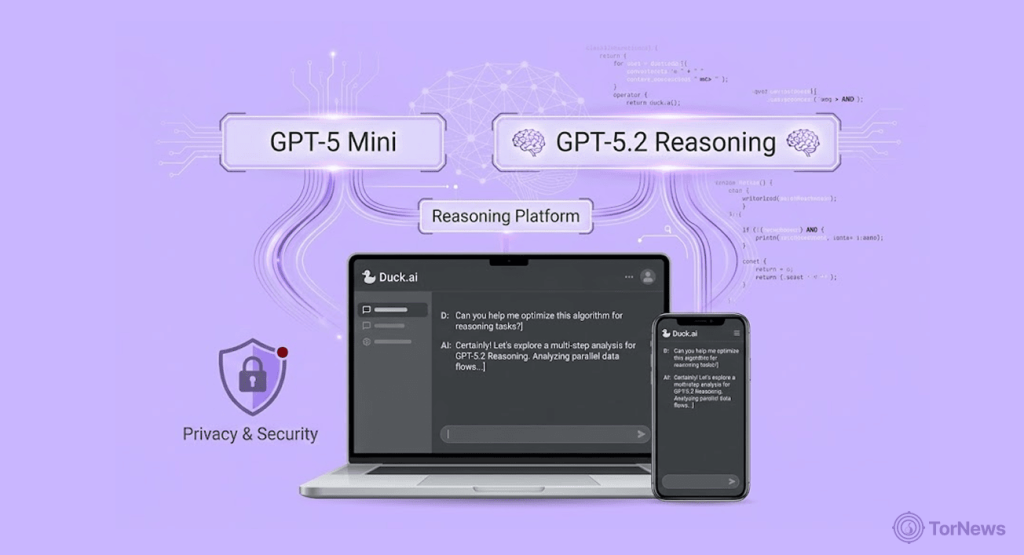
DuckDuckGo just rolled out a major upgrade to its AI platform. The privacy-focused search engine company now offers advanced reasoning models that tackle complex problems differently than traditional AI systems.
How the New Reasoning Models Work
Duck.ai now supports two new reasoning-capable models. Free users get access to GPT-5 mini, while subscribers can use the more powerful GPT-5.2. Both models follow a structured workflow that sets them apart from conventional AI responses.
The system first breaks down the query, then considers multiple ways to approach it. If it needs additional information, it searches the web for relevant sources. Finally, it assembles everything into a quality answer.
This process takes longer than standard AI responses. But DuckDuckGo says the trade-off delivers significantly better accuracy and usefulness.
The same democratization of advanced AI that powers DuckDuckGo’s helpful tools is also transforming cybercrime, with AI hacking tools now available for rent for less than the cost of a Netflix subscription, allowing criminals with minimal technical skills to launch sophisticated attacks that previously required deep expertise and custom-built software.
The company designed these models specifically for complex tasks like multi-step planning, debugging code, and research that requires consulting multiple sources.
Toggle Between Speed and Depth
DuckDuckGo built in flexibility for different situations. The platform includes a toggle for GPT-5.2 that lets you switch reasoning mode on or off within the same conversation.
The company points out that reasoning models aren’t necessary for every query. “While reasoning models provide more thorough answers, they may not be necessary for simple or time-sensitive queries,” DuckDuckGo notes in its announcement. Users should choose based on what they actually need.
This launch continues DuckDuckGo’s expansion beyond search. The company founded its reputation in 2008 on a privacy-first search that minimizes data collection and avoids tracking users.
Duck.ai extends that philosophy into AI tools, positioning itself as an alternative to mainstream AI services that often require accounts and may use your conversations for model training.
Duck.ai pulls models from multiple providers, including OpenAI, Anthropic, and Meta. But DuckDuckGo anonymizes all user requests through proxying and strips identifying metadata before sending queries to these providers.
Privacy Safeguards Remain Core Priority
The reasoning models arrive alongside other recent Duck.ai features. DuckDuckGo recently added real-time voice chat and AI-powered image editing. All these tools follow the same strict privacy approach.
DuckDuckGo emphasizes that AI interactions remain optional and that the company doesn’t store user data or use it to train underlying models. Any data shared with third-party model providers operates under contractual limits.
These agreements include deletion requirements and restrictions that prevent providers from reusing your information. Users who want to try the new reasoning models can reach them straight up via Duck.ai. The platform includes feedback options in its settings menu where users can report issues or suggest improvements.
For anyone using Duck.ai, experts recommend enabling reasoning mode selectively. Save it for sensitive decisions, technical troubleshooting, or research tasks that benefit from deeper analysis.
And always review the cited sources to validate what the AI tells you. Even advanced reasoning models can make mistakes, so the transparency feature serves an important purpose.
