In 2026, the dark web is far more monitored and contested than in its early “Wild West” days. Law enforcement and researchers now use advanced techniques like traffic analysis, behavior correlation, and AI-assisted investigations, sometimes successfully, sometimes not.
While tools such as Tor and Monero help protect anonymity, they are not enough on their own. Strong Operational Security (OPSEC) is what truly reduces the risk of identification.
This guide outlines practical OPSEC protocols to help you protect your identity and safely navigate the dark web’s encrypted layers. We uncover the OPSEC rules you should never break on the dark web while investigating or browsing the darknet out of curiosity to protect yourself.
A Word to Our Readers: This guide (like all the content on TorNews.com) is for informational and educational purposes only. It is intended for security researchers, journalists, and privacy-conscious individuals to understand operational security principles. We do not endorse or encourage any illegal activity. Accessing certain content on the dark net may be illegal in your jurisdiction; always comply with local laws.
What is OPSEC? Defining Your Threat Model
OPSEC (Operational Security) refers to the mindset and structured method for denying any adversary information necessary to identify, locate, or harm you. Encryption allows for the protection of message content, while OPSEC protects the context behind your actions.
An analogy would be: what Tor does for your identity by masking your face, OPSEC does for you by encouraging consistency in behavior, language, and activity patterns so that identification becomes more difficult.
Today, where AI stylometry and timing attacks are standard tools for investigators, having a “mask” is not enough; you must change certain online approaches. This evolution in offensive tactics—including widespread AI-powered identity theft and automated breach techniques—defines the modern threat landscape that necessitates strict OPSEC.
The Five Fundamentals of OPSEC
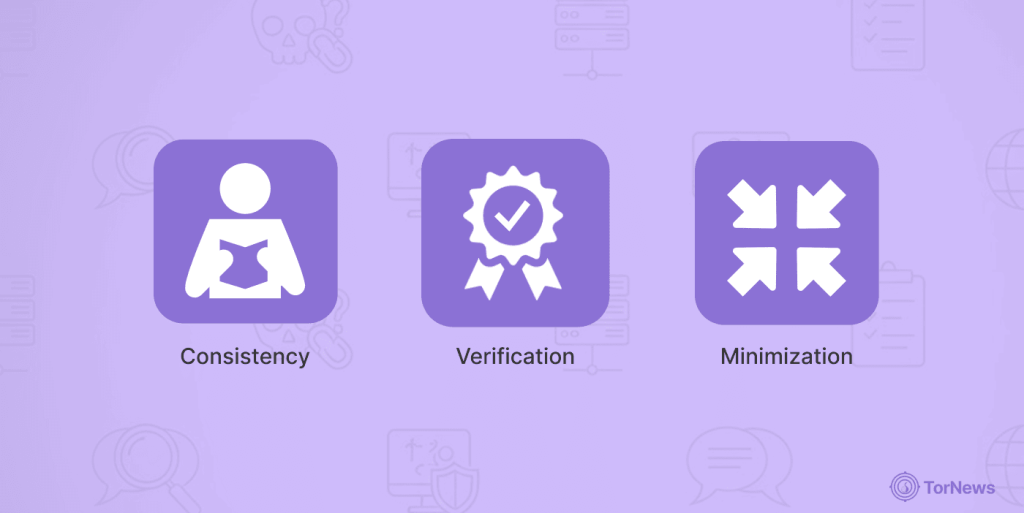
To master dark web anonymity when accessing it, you must internalize these five core pillars. These principles are commonly cited considerations for reducing digital exposure, depending on individual risk tolerance.
1. Separation
You should aim for a clear separation between your clearnet identity and your dark net persona. This means separate hardware, separate accounts, and separate mentalities. You need to make sure you never log on to a personal account (Gmail, Facebook, or Bank) from the same machine or network that you used for dark web activity.
2. Consistency
Anonymity is accomplished using the “Grey Man” principle, meaning you are so predictable and unremarkable that you are unnoticed. If your persona is a developer from Berlin, you cannot suddenly start using Texas slang or posting during US business hours. Any inconsistency is a thread an adversary can pull.
3. Compartmentalization
All activities should be compartmentalized (treated as individual cells). You should create unique usernames, PGP Keys, and Monero sub-addresses for every forum or marketplace. If one identity is “burned,” your other activities remain protected because they have no link to the compromised persona.
4. Minimization
The less data you put into the world, the less data can be used against you. Do not share your age, your hobbies, your location, or your profession. In a threat model where “Mosaic Theory” is used, small, insignificant details are pieced together to reveal a complete picture. Geographic data is especially critical, as it can immediately associate you with high-risk fraud markets, like those identified in the recent study on US states most vulnerable to surging identity theft.
5. Verification
The dark web lacks absolute trust. Whenever possible, confirm all .onion URLs from multiple trusted sites to eliminate potential impersonators or phishing schemes. Consulting updated and reputable directories of dark web sites can be a critical first step in this verification process. Be sure to also look for PGP signatures when having sensitive conversations.
The continued evolution of phishing and impersonation attempts throughout 2026 makes it critical to proceed cautiously with all unverified dark net sources.
Common OPSEC Failures
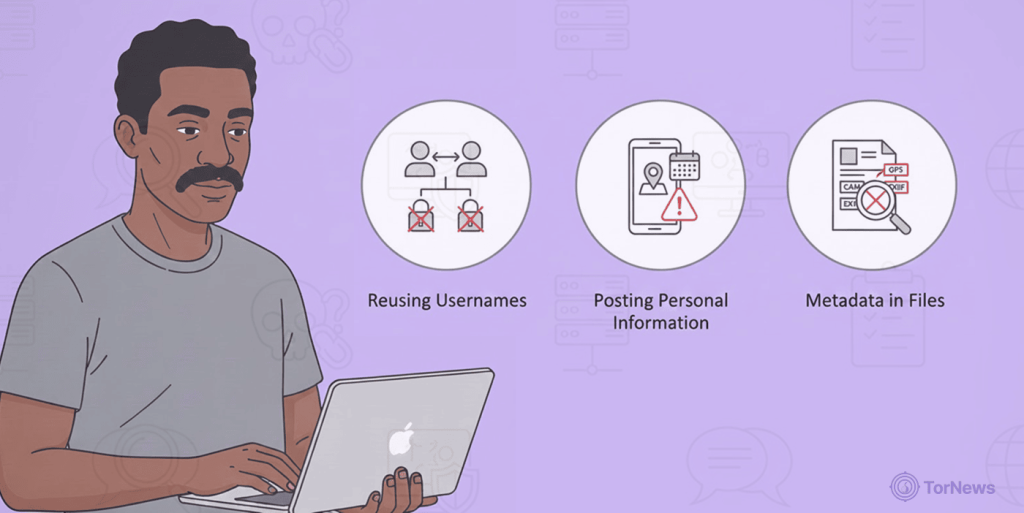
Understanding where others have fallen is the fastest way to harden your own operational security dark web strategy.
Reusing Usernames
Reusing usernames across different contexts can increase the likelihood of correlation, particularly in higher-risk scenarios. Investigators and researchers commonly use open source tools (OSINT) such as SpiderFoot and Maltego to search through years’ worth of web data to connect any “anonymous” usernames back to legitimate email or social media accounts.
Posting Personal Information
A detailed post such as “I am so happy to be out enjoying this sunny weather!” is not insignificant idle chit-chat! All of that information is being used to build information about you, particularly when paired with the time of a post and the corresponding local weather conditions from your computer’s time zone.
The scale of this risk is starkly demonstrated by massive, centralized data dumps, such as the recent leak of millions of U.S. driver licenses that now fuel the global identity fraud market on the dark web.
Investigators can use the timestamp of a post along with the local weather conditions to triangulate and narrow a user’s likely geographic region.
Metadata in Files
Files carry invisible fingerprints. A JPEG contains EXIF data (GPS coordinates, camera serial numbers), and a Word document contains author names and software license IDs. Use the Metadata Investigation Toolkit (MAT2) on Tails to scrub every file before uploading.
Time Zone Leaks
In addition to posting patterns that demonstrate when and where we engage online (fingerprint), Time Zone Leaks can also demonstrate geographic patterns of consistent users. Knowing these consistent patterns will enable users to determine how their online activities may give away personal information through the use of behavioral attributes.
Writing Style
Stylometric analysis (when augmented by Machine Learning algorithms) has proven capable of identifying writing similarities within investigations and academia under certain circumstances.
Although they are not 100% accurate, they become more realistic if users repeatedly utilize identical phraseology/punctuation and topic-specific vocabulary across multiple networks/platforms. Some users attempt to reduce distinctiveness in their writing style, though this is not foolproof.
Real-Life Examples
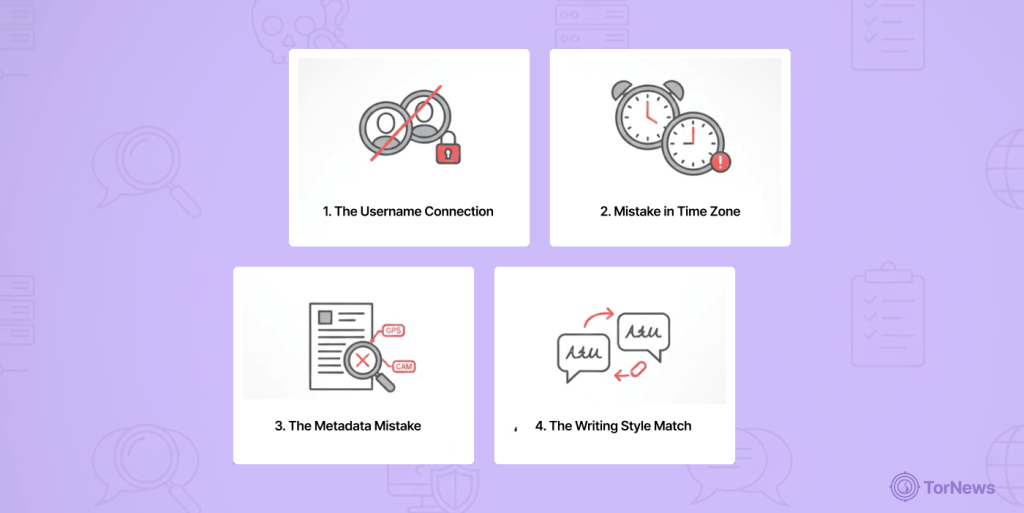
The Username Connection (The “Silk Road” Founder’s Case)
The original creator of Silk Road, Ross Ulbricht, was known by the alias “altoid,” which he used on both darknets as well as public forums dedicated to the cryptocurrency Bitcoin, to communicate with other users.
On the public forum, he mentioned his true Gmail account in one of his earlier posts. Just one username from this person led to the dismantling of an enterprise worth millions of dollars.
Mistake in Time Zone (The “Sabu” & “LulzSec” Cases)
Sabu was one of the most well-known hackers of 2011-2013. One of the ways that law enforcement was able to track them was due to the pattern of when he went online. His online activity would significantly drop off during hours matching those of a person who lives in Eastern Time, therefore narrowing down the search area for law enforcement, the FBI.
The Metadata Mistake (The Higinio Ochoa Case)
A hacker was caught after posting a photo of a document. While he thought the photo was safe, he forgot to strip the GPS metadata. The coordinates led police directly to his girlfriend’s house.
The Writing Style Match (The Unabomber Precedent)
While not dark web-specific, this remains the gold standard of stylometry. Ted Kaczynski was identified because his brother recognized specific phrases and linguistic quirks in the “Manifesto” that matched his personal letters.
Your OPSEC Checklist
Before Going Anonymous
- Hardware isolation: In higher-level privacy environments, users are able to operate on isolated devices specifically for downloading and conducting sensitive activity. By doing so, any accident that may arise through using the separate device for personal account access, as well as casual browsing, can not result in cross-contaminating any sensitive/private identity (no matter how/where the device was acquired).
- Network hygiene: Understand that using a public Wi-Fi source located further from your home will provide better immunity against IP geolocation searches than when using a standard connection to a service provider located closer.
- Secure software programs: Boot into Tails OS from a USB drive for increased security and anonymity, as Tails does not store any data on the computer’s hard drive.
During Anonymous Sessions
- Browser security: Set the Tor Browser security level to “Safest” (disables JavaScript).
- Safe navigation: Only use trusted resources for discovery. (Pro tip: You can bookmark our list of the top dark web search engines to avoid malicious directories.)
- Persona management: Never mention real-world events. Maintain consistency with your assumed online persona.
- No side-channel leaks: Do not have your smartphone in the same room, as smartphones can introduce additional tracking vectors.
After Anonymous Sessions
- RAM wipe: You will need to do a full shutdown of Tails OS in order to wipe memory.
- Physical security: Store the Tails USB somewhere secure, such as encrypted storage or a signal-shielding pouch.
Advanced OPSEC Techniques

Operating System Isolation
Modern consumer operating systems collect significant telemetry by default. To improve privacy protections, some users choose Tails or Whonix. Whonix reduces the risk of IP exposure by routing traffic through a gateway VM, though no system can remove all risk.
Hardware Isolation and Air-Gapping
Security researchers and incident responders sometimes use air-gapped systems for key storage in high-risk threat scenarios—but only when strict operational discipline is realistic. These machines stay offline at all times, and data moves via “clean” USB drives that are scanned beforehand.
- Air-gapped systems: For highly sensitive files, use a computer that has never been connected to the internet.
- USB hygiene: Never plug a USB drive from your “normal” life into your dark web machine. In some cases, compromised removable media may introduce malware that attempts outbound connections when reconnected to the internet.
Location Security
Avoid using Tor from your home IP. In some jurisdictions, network operators may be able to infer the use of anonymity networks based on traffic characteristics, though this capability varies widely by region, provider, and legal framework. For most users, the primary risk remains behavioral rather than purely network-based.
MAC address randomization may reduce certain forms of device fingerprinting.
Cryptocurrency Privacy
Bitcoin is “traceable cash.” Privacy researchers, however, view Monero (XMR) as a cryptocurrency that has more privacy built in at the base level compared to Bitcoin due to the use of ring signatures, stealth addresses, and confidential transactions. Monero is untraceable, private, decentralized, and fungible.
No matter which cryptocurrency you use, your transaction’s privacy depends on your behavior, how exchanges operate, and how you secure each transaction’s endpoints—even if the sender uses an anonymity service. Improper wallet handling, reuse of identifiers, or interaction with regulated exchanges can still expose transactional links.
Some users employ additional wallet hygiene techniques, though these require careful understanding of risks and limitations.
The Stylometry Trap
Written communication often shows stylistic patterns that can be compared across texts under certain conditions. Artificial Intelligence can use Stylometry Tools to explore these unique “DNA markers” within your written pieces.
Therefore, if you or someone else were to create a profile using text-based content found on the daknet or from any other source, an AI would be able to connect that data with any other social media accounts you may have created from that same writing.
Always use neutral language. Avoid unique slang, and never mention personal details like the weather, your time zone, or local news.
Threat Models
These examples illustrate concepts and do not serve as fixed guidelines.
Low Threat—Casual Privacy
- Goal: Avoiding ISP tracking and ad-targeting.
- Protocol: Standard Tor Browser on a personal PC with JavaScript disabled.
Medium Threat: Serious Privacy
- Goal: Protecting identity from corporate or small-group adversaries (Journalists/Activists).
- Protocol: Tails OS, PGP encryption for all DMs, no personal identifiers.
High Threat: Advanced Adversaries
- Goal: Avoiding detection by state-level actors (Nation-states).
- Protocol: Dedicated hardware, Whonix on Qubes OS, Monero only, linguistic masking, and hardware-disabled peripherals.
Social Engineering Defenses
Technical security is not able to protect you from your own trust; therefore, social engineering defenses are necessary.
Common Social Engineering Tactics
The use of AI voice cloning and the impersonation of administrators to trick you into doing something is common in social engineering tactics in the digital space. An attacker may lure you with a free security tool, which is actually a remote access Trojan that steals your anonymity.
Defense Strategies
Defensive strategies will include implementing a zero-trust policy that states you will never give personal information to anyone, no matter how trustworthy they may seem; verify every message claiming to be from an administrator by checking for a PGP-signed “canary” or public key on an official website.
Maintaining Discipline
Remain Focused
OPSEC is like a muscle. If you’re tired, intoxicated, or distracted, stay offline. It’s as easy as clicking on one clearnet link while your Tor is open, which can create a lasting association between your IP address and your session.
Take Advantage of Your Mistakes
If you suspect an identity has been leaked, don’t try to fix it yourself. Discontinue use of the compromised identity. Delete the accounts, generate new PGP keys, and start over. It is easier to build a new persona than to hide a compromised one.
Regular Updates
The cybersecurity landscape of 2026 moves at the speed of AI. Follow the Tor Project’s official blog and security researchers to stay informed about new “Zero-Day” exploits that could bypass your current defenses.
Practical Daily OPSEC – Physical OPSEC (Your Real-world Footprint)
Physical security is the most overlooked part of any dark web anonymity guide. If someone compromises your physical space, your digital tools become useless.
The “Hacker Den” Configuration
For higher-risk privacy use cases, you need a dedicated, secure space:
- Stationary setup: Use a laptop specifically for sensitive tasks. Always power down the device when you finish using it. If left on, anyone can intercept the signals and access your information.
- Signal screening: When not using devices, store them in a Faraday bag or something similar to prevent any way of tracking and/or leaking out your information through Wi-Fi/Bluetooth.
Power Management: The “Cold Sleep” Rule
Encryption only protects the device when it is turned off.
- RAM clearing: Once the device goes into sleep mode, all encryption keys still remain in the RAM, allowing an experienced adversary to retrieve them via a method known as a “Cold Boot Attack”.
- Full shutdown: Always shut down completely. This process flushes the RAM and locks your VeraCrypt or LUKS volumes.
In general, you should develop a ‘Privacy Habit.’ For example: use Signal or Session for chat (have private conversations through private channels). Go with DuckDuckGo or SearXNG for searching. Use KeePassXC for storing your passwords.
The more often you act like privacy is normal for you, when privacy is vital for anonymity, you will have fewer opportunities to make errors about privacy.
Conclusion
In 2026, navigating the dark web is no longer just a technical challenge—it’s a test of discipline, awareness, and responsibility. True anonymity isn’t something you can buy with software alone; it requires consistent OPSEC practices every time you go online.
As AI-driven surveillance continues to expand, protecting your privacy means more than hiding your location—it’s about asserting your right to communicate freely. Maintaining anonymity demands ongoing, lawful privacy hygiene and a clear understanding of its limits.
FAQs
The vast majority of democratic nations consider access to and utilization of dark web content as not illegal. And people access it to escape censorship. Journalists, activists, and citizens concerned about their online privacy are all occupants of the dark web. Many countries outlaw certain activities on the darknet, including making illegal purchases or accessing data that the law does not permit. The operational security dark net protocol must always be operated legally, with respect for how to protect your privacy.
Tor encrypts your info in layers. Some security researchers discuss Tor-over-VPN setups, though recommendations vary by threat model. This Tor over VPN method keeps your internet service provider from seeing that you’re using Tor. Since internet companies might keep an eye on Tor-like activity, this may offer additional protection in some scenarios.
Tails OS is great for staying anonymous, but someone can still follow you by the way you act. If you log into your personal social media, reuse the same username you use on the regular internet, or talk in a way that people can figure out who you are, then it doesn’t matter how secure you are. Using Tails to maintain the security of your computer and your Internet Protocol address is good, but if you take extra precautions to protect your identity, it will help even more.
Unlike Bitcoin, Monero actively hides all transaction details, including who sent the funds, who received them, and the exact amount transferred. Monero’s design fully conceals senders, receivers, and transaction values, which makes it a top choice for users who want to keep their money and transactions private. Compared to the privacy of Bitcoin, Monero has a significant improvement in its privacy features, though mistakes from exchanges, operational oversight, and terminals provide opportunities for the breach of Monero’s security.
The #1 failure is identity leakage through oversharing. Users often get comfortable in darknet communities and mention small details—like their local time, weather, or job industry. Adversaries use “Mosaic Theory” to piece these small breadcrumbs together until your real-world identity is the only logical conclusion.