The dark web has always existed on two extremes: a vital tool for whistleblowers and those evading censorship, and a risky space where stolen data and lost bitcoins are common threats. With the rise of AI-driven phishing scams and deepfake social engineering, the Tor Network in 2026 may empower increasingly sophisticated cybercriminals.
We’ve studied the Tor Network and the activities of dark web vendors to provide guidance on best practices for staying safe. Whether you’re curious or serious about privacy, understanding how to avoid dark web scams is the key to protecting yourself.
A Note to Readers: This content serves as an educational overview of dark web threats. Engaging with these spaces carries significant legal, financial, and security risks. We do not endorse any illegal activities.
What is the Dark Web and Why It Matters
In general, the Dark Web is a part of the Internet that cannot be accessed directly through normal web browsers and cannot be found by normal search engine indexers. The Dark Web can only be accessed using certain tools that have been developed to help people maintain their anonymity, such as the Tor Browser and Tails Operating System.
These tools help protect people’s identities by hiding their IP addresses and routing their Internet traffic through a number of layers of encryption. While these types of tools help protect people’s privacy when accessing the Dark Web, they also create a space for cybercriminals to operate outside of traditional policing.
There are many different ways in which you can use the “dark web,” (that includes) everything from legitimate reasons such as “whistleblower platforms,” “data sharing for researchers,” and “groups/users who value their privacy,” right through to illegal and illegitimate uses such as “selling stolen information by cybercriminals,” “phishing sites that look real,” and “fraud/ scams.”
With cybercriminals always evolving their methods for scamming users on the dark web, understanding how the dark web works will provide the tools to keep you safe while engaging in it online.
Why Scams Thrive on the Darknet
We have found that the dark web is the perfect environment for fraudulent activity because it lacks the traditional safety nets of the surface web.
Here are some reasons scams still thrive on the dark web:
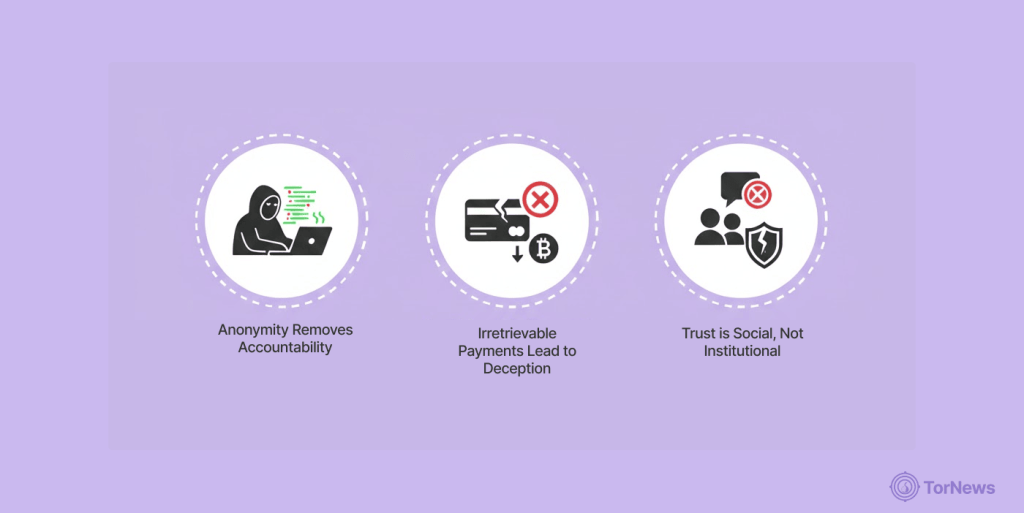
Anonymity Removes Accountability
The dark web runs on anonymity. Tools like Tor are meant to hide who people are and where they’re located. This is key for staying private, but it also means no one is really held responsible. Scammers know they can disappear instantly, abandon identities, and resurface under new aliases without consequences.
Unlike the surface web, there are no banks to reverse payments, no customer service departments, and no regulators to enforce rules. This creates an environment where dishonest actors face little risk.
Irretrievable Payments Lead to Deception
The majority of transactions on the dark web use cryptocurrency. Once someone transmits cryptocurrency from one account to another, that transaction is irreversible. As a result, scammers take advantage of this unique feature because it means that victims have no way to recover their funds if something goes wrong with their transaction.
This type of payment structure is valuable to scammers, thus making it very easy for them to perpetrate fraud, and it can be very financially damaging for innocent victims who make even minor mistakes.
Trust is Social, Not Institutional
Trust on the dark web is built through forums, vendor ratings, and community reputation, not legal protections. These social trust systems can be manipulated through fake reviews, coordinated accounts, or long-term grooming strategies.
Typical Dark Web Fraud: Common Scam Types
To ensure effective dark web scam prevention, we must look at the specific methods used to drain wallets in 2026:
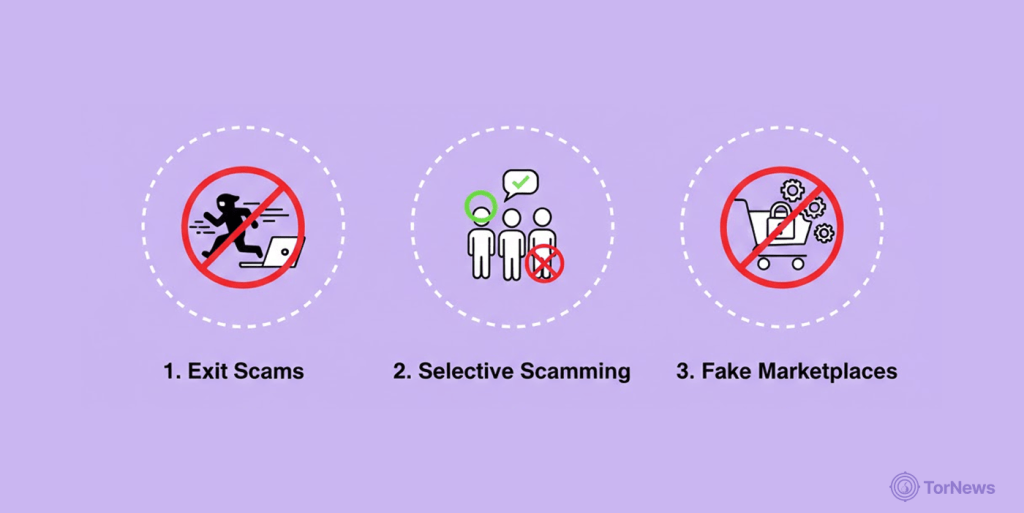
1. Exit Scams
During our long-term monitoring of the darknet landscape, we have witnessed the rise and fall of dozens of marketplaces. An exit scam is a calculated “long con” where a market operates legitimately for months or years to build massive trust.
Once the platform reaches its peak volume, the administrators suddenly disable withdrawals while still allowing deposits to flow in. Within days, the site vanishes, and the admins disappear with millions in user cryptocurrency held in escrow.
This is perhaps the most devastating scam because even cautious users, in certain circumstances, can be caught off guard if they keep a balance in their marketplace wallet. We have noticed that markets often exit scam during periods of high market volatility or following the “bust” of a competitor, as they anticipate a surge in new, unsuspecting users who haven’t performed their due diligence.
Why It Works
- Established trust: Users feel a false sense of security because the site has functioned normally for a long period.
- Centralized control: The market admins hold the private keys to all “hot wallets” on the platform.
- Lack of red flags: The site usually appears to function perfectly right up until the moment it goes dark.
2. Selective Scamming
Selective scamming is a serious hazard in marketplaces because it was designed specifically to evade detection by the community. It occurs when a vendor fulfills the majority of their smaller sales to maintain their high feedback score and then selectively “forgets to ship” or “loses” their larger sales.
As a result, a vendor may have thousands of positive reviews, and the community will often dismiss the odd negative review from a user who was scammed as a “shill” or “outlier”. We have observed that scammers often target users who have not enabled PGP encryption for their messages or appear to be inexperienced.
As long as a scammer maintains a 95% success rating, they may remain active on the marketplace for years without incurring a ban. The scammer plays a psychological game with the abundance of positive information about themselves, operating to obscure the opinions of their victims.
Why It Works
- Padding/Masking: The vendor uses a high volume of legitimate small sales in order to mask the high-value thefts.
- Community skepticism: Other users tend to favor a “reputable” vendor over a single user who raises an issue.
- Longevity/Continual revenue: The vendor is able to generate continual revenue over an extended period of time, as opposed to the volatility of a one-time payment.
3. Fake Marketplaces
Phishing remains one of the primary ways users could lose their credentials in 2026. Scammers create “Mirror Sites” that are visually identical to popular marketplaces. We have tested these clones over multiple years and found that they often feature working login boxes that actually “ping” the real market to see if your password is correct before stealing it.
Once you are logged into the fake site, any funds you deposit go directly into the scammer’s wallet instead of your marketplace account. These sites are frequently promoted on fake pages or via SEO-optimized clear-web blogs that claim to provide “official” onion links.
If you aren’t manually typing your links from a PGP-verified source, you are essentially handing your keys to a thief. We have even seen fake markets that allow you to browse products just to make the experience feel authentic.
Why It Works
- Visual copying: These sites have the same logo and Layout as genuine platforms, and they are using identical CSS.
- Search engine traps: Scammers usually purchase “sponsorship” on dark web search engines to have their links appear at the top of results.
- Credential harvesting: Even if you don’t deposit money, the scammer now has your username and password to try on other sites.
4. Vendor Impersonation
Identity theft isn’t just a clear-web problem. Scammers regularly set up identities under an alias on the dark web – typically with usernames very similar to well-known, reputable vendors. For example, they could swap out a letter “I” for the digit “1” or add a tiny underscore to their account name.
Such impersonators can be seen in many different forums, making contact with individuals who may be interested in purchasing items, and providing “special discounts” if the exchange is undertaken off-platform. By riding on the coattails of a respected name, the scammer bypasses the victim’s natural skepticism.
If you receive an unsolicited message from a “top vendor” asking you to move to Telegram or Wickr for a better price, our advice is simple: block them immediately. The real professionals do not need to hunt for customers in private messages. Remember, if you ever need to communicate off-platform privately for legitimate reasons, it’s essential to use properly encrypted messaging apps, not just popular mainstream ones that claim privacy.
Why It Works
- Human error: Users in a hurry often fail to notice subtle character differences in a username.
- Reputation Hijacking: The scammer leverages years of hard work by a legitimate vendor to gain instant trust.
- Direct transaction lure: Offering a lower price “off-market” appeals to the buyer’s desire to save money.
5. Too Good to be True Deals
The dark web is not a magical place where the laws of economics don’t apply. We frequently encounter listings for “1:10 Transfers,” where a scammer claims they will send you $1,000 in stolen PayPal funds if you send them $100 in Bitcoin.
These are 100% fraudulent. During our research, most “money doubling” or “transfer” services are not legitimate. These scams play on human greed and the desperation of those looking for a quick financial fix.
Usually, legitimate vendors on the dark web are businesspeople with overhead costs; they have no reason to give away money or sell high-end electronics at 90% discounts. Deals that come across as unbelievable can be traps to exploit people’s money.
Why It Works
- Greed over skepticism: The promise of high returns for low effort can blind even the most cautious users.
- Emotional targeting: These scams often target people who are already in financial distress.
- Low entry cost: Scammers often keep the “buy-in” price low enough that victims feel it’s a risk worth taking.
Red Flags
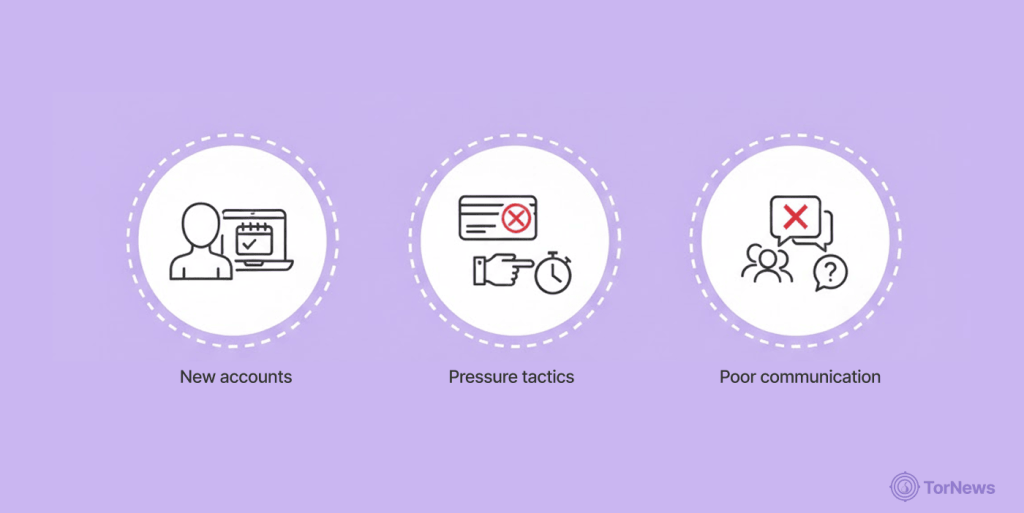
Identifying a scam before you pay is the core of how to avoid dark web scams:
- New accounts: While everyone starts somewhere, vendors with zero history are high-risk. We suggest new users stick to “Senior” or “Trusted” vendors who have a history of successful deliveries.
- Pressure tactics: If a site or vendor uses countdown timers or messages like “Only 2 left! Buy now!”, it is a red flag. Legitimate dark web commerce doesn’t rely on high-pressure sales tactics.
- Poor communication: Scammers typically respond with “hot air”, generic responses, or canned answers. If a vendor cannot respond to your specific inquiries concerning the particular item or the shipping procedure for that item, do not give them any of your money.
- Payment demanded outside the platform: If a vendor asks you to pay them directly via Telegram or email to “save on fees,” walk away. They are trying to bypass the market’s escrow system, which is your only protection.
- No reviews or all perfect reviews: Zero reviews mean no track record. Conversely, 500 reviews all say “Great vendor!” with the exact same phrasing are likely fake bots. Real vendors will have a mix of reviews with detailed, specific feedback.
Verification Methods
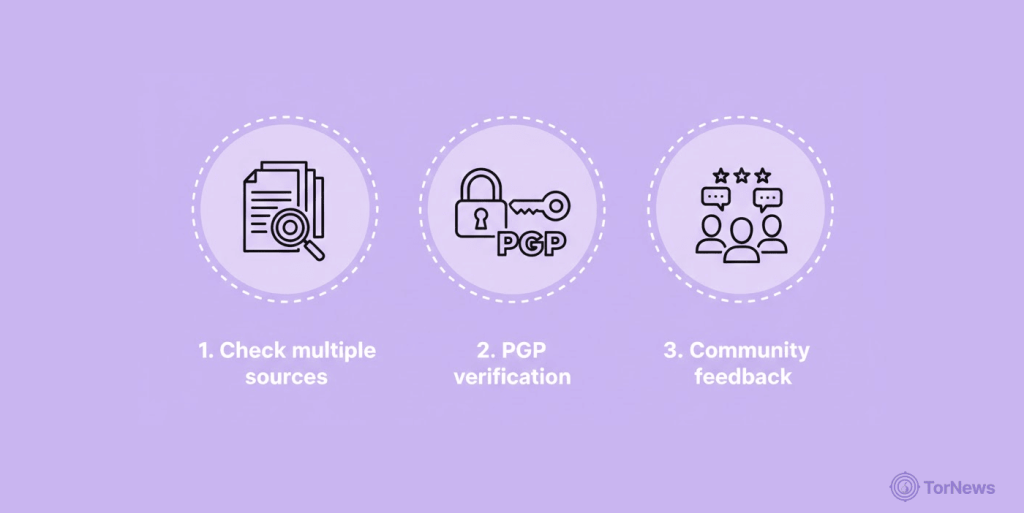
Trust nothing, verify everything. This is our mantra for staying safe on the dark web:
- Check multiple sources: Never rely on a single directory. We cross-reference .onion addresses across at least three independent, trusted sources before entering our credentials.
- PGP verification: This is the most critical component of dark web security best practices. We use PGP signatures to double-check that a message or link really comes from the site admin. If the signature is wrong, the link’s a fake.
- Community feedback: We actively monitor forums like Dread and Daunt. These communities act as a “neighborhood watch,” quickly flagging new phishing links and selective scammers.
- Start small: When testing a new vendor, we always start with the smallest possible order. Think of this “test order” as an insurance premium; it is better to lose $10 than $1,000.
Marketplace Safety
When we evaluate a marketplace, we look at the structural protections it offers its users. The landscape changes frequently, but ongoing reviews of the top dark web markets can reveal which platforms currently offer the best escrow, moderation, and user protections:
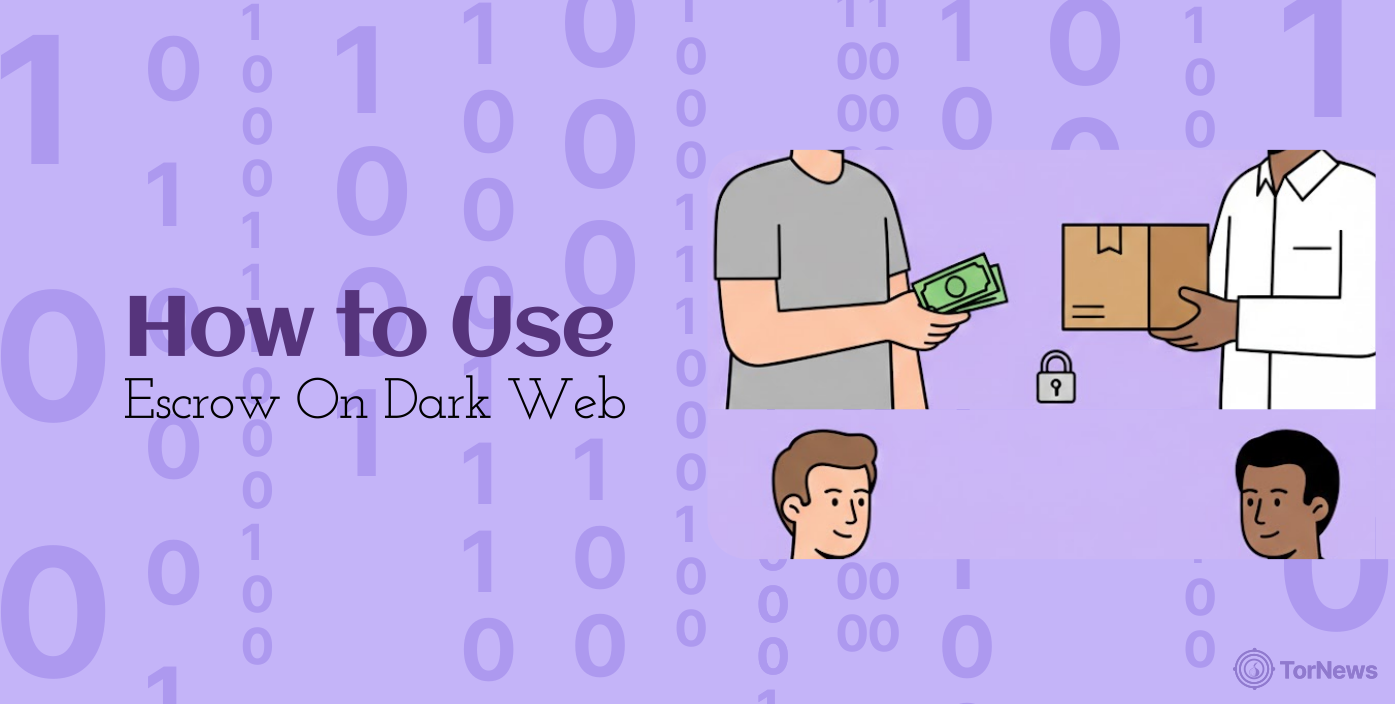
- Use escrow: Escrow is non-negotiable. It holds your funds in a “third-party” account until you confirm the product has arrived. Never “Finalize Early” (FE) unless you have a multi-year relationship with a vendor.
- Check vendor ratings: Don’t just glance at the score of vendor ratings; check the history. If a seller was amazing a few years ago but has lots of bad reviews now, chances are they’re planning to rip people off and disappear.
- Verify product listings: Scammers often steal high-quality photos from legitimate sites. We use reverse image searches (when possible) to see if a product photo is being used by 10 different “vendors.”
- Monitor forum warnings: Before making a large purchase, we always search the vendor’s name on community forums. If there is a “Warning” thread about them, we cancel the transaction.
Financial Protection
Your choice of currency is your first line of financial defense:
- Never hold large balances: We treat marketplace wallets like a hot stove—don’t touch them for longer than necessary. Only deposit the exact amount you need for a purchase, and do it immediately before you buy.
- Withdraw winnings: For those selling goods or services, we recommend withdrawing your earnings daily. Do not let your profits accumulate in a wallet you do not control.
- Use Monero when possible: For awareness and personal protection, we advocate for Monero (XMR). Unlike Bitcoin, which has a public ledger that scammers can use to “tag” your wallet, Monero is private by default. It prevents scammers from seeing how much money you have.
- Limit loss exposure: We only use “disposable” amounts of crypto for dark web transactions. We recommend creating a dedicated wallet specifically for dark web use that is entirely separate from your main long-term savings.
Direct Deal Safety
“Direct Deals” (DD) are transactions made outside a marketplace’s escrow system. These are the highest-risk actions you can take:
- Avoid direct deals when possible: In our experience, a majority of “Direct Deal” offers from vendors you found on a forum are scams. Without escrow, you have no leverage if the package never arrives.
- If you must deal directly: Only do this with vendors you have used successfully at least five times through an escrow system. Even then, keep the transaction amounts small.
- Use multisignature escrow: For large deals and not to enable illegal activity, we suggest “2-of-3 Multisig.” This requires two out of three parties to sign off on the transaction. It is a technical but highly effective way to create a “DIY Escrow” for direct deals.
Recovering from a Scam
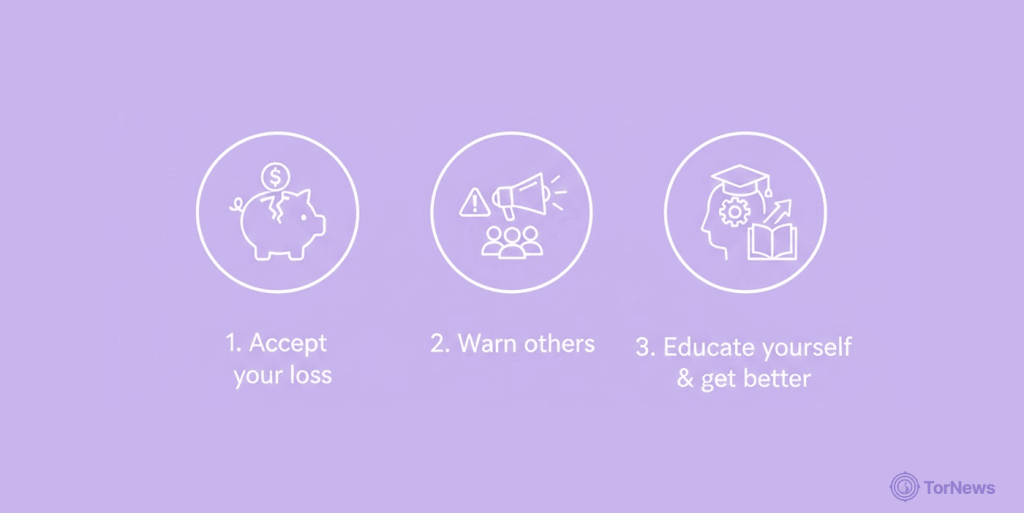
You should take action quickly in order to limit any additional chances for Identity theft:
- Accept your loss: Cryptocurrency transactions are non-reversible. Once confirmed by the blockchain, your funds will not return. Accepting your Initial Loss gives you the ability to move on to the next important step in dark web scam prevention in the future.
- Warn others: We believe in community protection. Post the vendor’s name, the fake link, and the details of the scam on forums like Dread. This “poisons the well” for the scammer and protects the next victim.
- Educate yourself & get better: After experiencing the scam, review it, and determine what exactly went wrong in your situation. Did you skip the PGP verification? Did you click a link from a clone site? Every scam is a lesson in how to avoid dark web scams in the future.
- Don’t fall for recovery scams: There is no such thing as a “Bitcoin Recovery Service.” Anyone who messages you claiming they can “hack the scammer” or “reverse the transaction” for an upfront fee is trying to scam you a second time.
Marketplace-Specific Risks
Each marketplace niche has its own unique dangers:
Honeypot Operations
Sometimes, law enforcement takes over a marketplace but keeps it running to collect user data. This is why we always use PGP encryption for our shipping addresses; it ensures that even if the market is a “honeypot,” the police cannot read our messages.
Vendor Bust Cascades
When a major vendor is arrested, their devices often contain a treasure trove of unencrypted customer data. This is why we never share personal info in clear-text, even if the vendor seems “safe.”
Social Engineering Scams
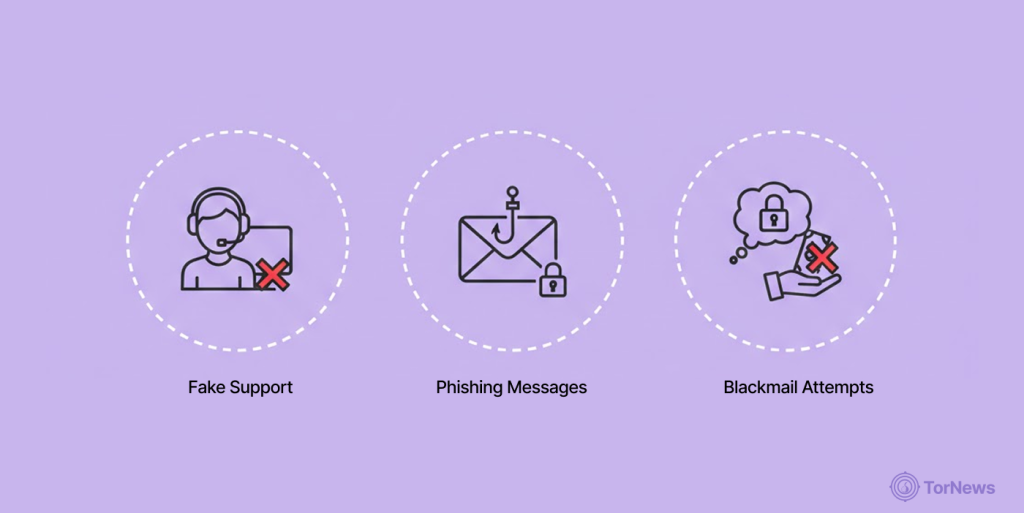
Scammers often use psychology rather than code to steal your funds:
Fake Support
A fake “Support Admin” might message you saying your account is locked and requires a “security deposit” to fix. Real admins will never ask for your crypto or password in a private message.
Phishing Messages
We frequently see messages that look like “System Alerts” claiming your password has expired. They provide a link to a “Reset Page” which is actually a phishing site. Always type your market address manually.
This reliance on urgency and impersonation isn’t confined to the dark web. We’ve seen the same playbook used in devastating mass campaigns on the clear web, like the recent smishing surge in India, where fake government texts drained countless bank accounts. It’s a stark reminder that the human psychology these scams exploit is universal.
Blackmail Attempts
Scammers may claim to have “video evidence” of you browsing the dark web and threaten to send it to your contacts. This is almost always a bluff based on leaked email lists. Disregard each of these messages and improve your OPSEC (Operational Security).
Staying Safe Long-Term
Your methods for avoiding danger while browsing the Internet will need to be embedded in regular routines through discipline to remain safe throughout your entire internet browsing history:
- Be skeptical: You should view every link and vendor as a possible risk until proved safe. On the dark web, being cautious is not an option.
- Stay informed: Like any other thing online today, scam techniques evolve fast. Spend 15 minutes a week reading the “Scam Alerts” section on Dread to see what new tricks are being used in 2026.
- Build a trust network: Once you find a vendor that has fast service, is reliable, and implements PGP in accordance with proper protocol, develop a habitual relationship with that vendor; each time you switch vendors, you increase your level of exposure to an increased amount of risk.
- Document everything: Always maintain local, encrypted records of your purchases and of the vendors’ (and your own) PGP keys so that if there is ever a dispute, you will have an abundance of evidence to prove, by way of screenshots and PGP mixed messages, that the vendor is responsible.
Troubleshooting: The “Web Player” Strategy
If you are researching dark web marketplaces or directories on the “Clear Web” (the regular internet), be careful of dedicated apps. We have noticed that many mobile apps use high-level device permissions to verify your GPS location or device ID.
If you are following a guide on your phone, avoid the app and use a Web Player or mobile browser in “Incognito/Private” mode. Web players have stricter hardware sandboxing, which prevents the site from accessing your GPS or sensor data, keeping your research phase secure.
Conclusion
The dark web offers anonymity but little accountability, creating opportunities for scammers to exploit inexperienced users, especially with irreversible crypto transactions.
Tools like PGP encryption, escrow services, and decentralized cryptocurrencies help, but they aren’t enough on their own. Human error—rushing transactions, clicking unverified links, or ignoring protocols—remains the biggest risk.
Staying safe on the dark web depends less on tools and more on discipline: verifying interactions, following OPSEC procedures, and staying informed about evolving scams are essential for long-term security.
FAQs
In most cases, yes; however, it varies by country since different cultures perceive and tolerate the Tor Network differently. Even if the Tor Network is a tool for people wanting to have privacy, accessing and buying anything illegal will be the same, no matter what type of Web browser you are using.
Using a VPN gives users a degree of anonymity on the dark web by hiding their IP address from activities conducted through the Tor browser. However, a VPN does not protect users from scams that occur on the dark web or within its marketplaces.
Not all dark web markets are scams, but users should treat every dark web marketplace as a potential risk. Legitimate dark web markets do exist, but they are subject to shutting down (exit scams) at any given time. You should always use a 2-of-3 multi-sig escrow when dealing with any dark web market.
Phishing remains the most common method scammers use to deceive people online. Users receive an email from what seems to be their favorite e-commerce site with an enticing link (mirror link) created in such a way that it appears to be the actual e-commerce site to the user, allowing the user to enter their credentials (username and password) into this link. Soon after, scammers drain the victim’s account.
The safest way to access the dark web is to use a USB thumb drive running Tails OS and pair it with a reliable VPN service, such as NordVPN, to prevent any evidence from being saved on your computer and to add an extra layer of anonymity while browsing.