-
More than fifty percent of the respondents completed the survey by saying cybercrime is a component of thirty percent or more of aggregate crimes documented throughout their respective nations.
-
Ransomware was responsible for over 135000 incidents worldwide; phishing was still the most prominent type of cybercrime.
-
The use of deep fake technology increased by 600 percent in the past four months when discussing usage amongst Southeast Asian criminal entities.
Cybercrime is no longer a side issue in Asia and the South Pacific; it’s a major part of everyday crime now.
According to a recent INTERPOL report, cybercrime is increasing at a very rapid pace with the bulk of growth occurring in the Asia-Pacific region.
Other forms of cyber-crime such as online scams, phishing, ransomware, etc., are growing rapidly because more people are now banking, shopping, and working virtually.
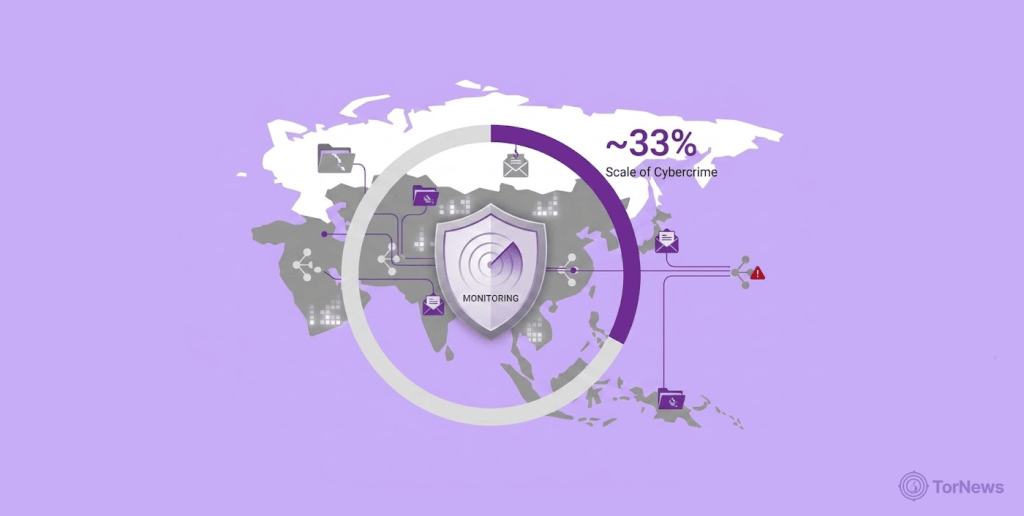
Approximately one-third of all crimes in the Asia-Pacific are now committed over the internet. This is a significant change.
Cybercrime is Taking The Center Stage
INTERPOL surveyed 18 countries across the region. More than half of them said cybercrime now accounts for at least 30% of all crimes recorded in their countries. It’s clear online crime isn’t just a side problem anymore; it’s front and center for law enforcement.
The tactics are also getting sharper. INTERPOL points out that today’s cybercriminals aren’t just lone hackers in dark rooms. They’re operating more like organized businesses. Some even partner with other threat actors across borders. They share tools and offer services too, just like global firms do.
Phishing and Ransomware Still the Top Threats
Phishing is still the most common cybercrime and the most financially damaging too. About one-third of the countries Interpol surveyed witnessed over ten thousand phishing incidents.
Cybercriminals impersonate banks, businesses, individuals, etc. to send out fraudulent emails, texts, links and other means in an attempt to deceive users into providing their passwords and/or financial information.
Researchers discovered that of every 1,000 individuals, 5.5 clicked on phishing links every month; this is approximately 2 times the global average. Attackers especially go after cloud apps since they’re packed with sensitive data from companies and their customers.
Ransomware attacks also remain a serious problem. INTERPOL tracked over 135,000 in the region alone. Who took the hardest hit? Manufacturing companies. Financial institutions got hit hard too. And real estate firms also were top targets.
And ransomware-as-a-service is fueling the problem. With this model, just about anyone, skilled or not, can launch complex attacks by renting tools. It has made ransomware easier to deploy and has increased the number of groups capable of carrying out attacks.
DDoS Attacks and Data Breaches Also Rising
DDoS attacks are also on the rise, with more websites getting bombarded with traffic and knocked offline. The new report revealed a whopping 92 percent spike in DDoS activity in 2024 compared to last year.
Data breaches are another major concern. About 80 percent of reported breaches were as a result of system intrusions. Malware appeared in 83 percent of incidents. And ransomware appeared in 51 percent of cases.
AI and Deepfakes are Changing the Game
Criminals are using more sophisticated methods now that AI is available to them. INTERPOL reported that there has been a massive increase in the amount of conversation around deepfakes on the cybercriminal forums and Telegram channels of many of the advanced threat actors in Southeast Asia.
In fact, during the period of February 2024 to June 2024 there has been an increase of greater than 600 percent in discussions that reference the use of deepfakes.
Deepfakes are the products of the use of AI to generate highly realistic-forged images, videos, or audio. Criminals use them for fraud, impersonation, and social engineering.
For example, some documented cases show scammers have used deepfake videos to pose as executives of a corporation during video calls and have successfully convinced employees to transfer money to the scammers.
According to security research, the use of AI is making it significantly more difficult to detect these types of scams and much easier for criminals to pull off the crimes.
Criminals are now capable of producing a voice that sounds almost identical to the victim, generating fake videos, or sending victims an automated message to deceive them into giving them money or account access. This is helping criminals run large-scale scam operations.
What the Authorities are Doing About the Issue
INTERPOL said the findings show why international cooperation is key. Many attacks cross borders, and investigations often need coordination between multiple countries. The agency’s Asia and South Pacific Joint Operations Against Cybercrime program is working to improve intelligence sharing and joint operations.
These efforts are paying off. An INTERPOL sweep across Africa recently resulted in 574 arrests for fraud and dark web crimes, demonstrating the effectiveness of coordinated action.
Some countries are already taking action. Roughly two-thirds of countries in this survey are already using AI for things like predictive analysis, digital forensics, and spotting threats online. On top of that, a lot of these places are tightening laws against cybercriminals and pouring resources into dedicated police squads.
The big takeaway? Cybercrime has leveled up, it’s not just more widespread, it’s slicker, more efficient, and way more high-tech than before.
And as more of our lives move online, the risks keep piling up for governments, companies, and regular people. In a lot of Asian and South Pacific countries, cybercrime isn’t some distant worry, it’s already hitting home. It is already one of the biggest public safety and economic challenges of today.
