-
In Florida, USA, two individuals have been sentenced to prison for creating and distributing imitation Xanax. One was given an 80-month term, while the other received a 45-month term.
-
The individuals mixed clonazolam and etizolam together to create imitation Xanax pills that looked very similar to original Xanax pills.
-
They sold these knockoffs straight to buyers and through dark web sites, taking payment in cryptocurrency and shipping orders all over the country, even as far as Kentucky.
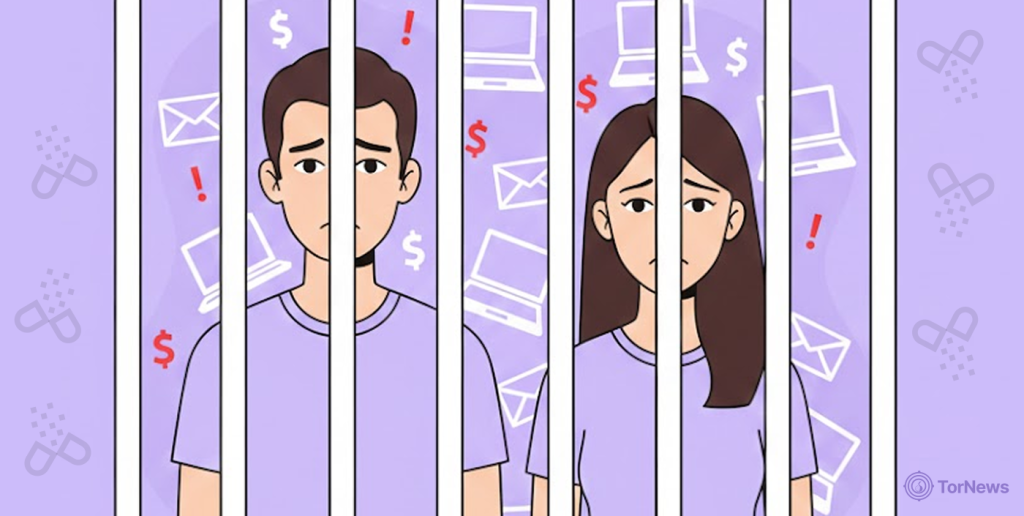
A man and woman from the state of Florida are to be locked away in federal prison. According to reports, they both conspired to manufacture and sell counterfeit pills. Their operation spanned the dark web. They shipped the fake drugs across the country.
The Counterfeit Pill Conspiracy
Michael Basalyga, 36, and Reina Chirinos de Urena, 39, both from Boca Raton, were sentenced in October. A federal judge in Kentucky handed down the sentences. Basalyga received 80 months behind bars.
Chirinos de Urena, who admitted that he connived with some others to make fake alprazolam (the active ingredient in Xanax), got 45 months behind bars.
The group meticulously designed their pills. They made them look like the real thing. This included stamping them with numbers used by legitimate manufacturers. But the pills were not authentic. Those pills weren’t just fake, they actually had stuff like clonazolam and etizolam — strong research chemicals that try to copy what real Xanax does.
Their sales strategy was twofold. They sold directly to known customers. They also used fake names on darknet marketplaces. Buyers from across the United States, including Kentucky, used cryptocurrency to purchase the drugs. Under federal law, both must serve 85% of their prison sentences.
A Major New York Dark Web Takedown
Selling drugs online is out of control these days, and law enforcement is going after these dark web operations hard. Just recently, there was another high-profile case in New York, in which the authorities took down a big trafficking ring.
Alvin Bragg, the Manhattan District Attorney, said that five people have already pleaded guilty to being involved with a dark web vendor called “FireBunnyUSA.” This drug operation was massive – they sent over 10,000 packages of drugs to every single state in the country.
The ring sold cocaine, MDMA, and Ketamine. They laundered over $7.9 million in proceeds. The way they ran their operation was mainly by using crypto to hide where the money was going. They swapped out Bitcoin for Monero, since Monero’s a lot tougher to track.
Nan Wu, who ran the whole operation, is looking at at least six and a half years behind bars. His buddies got jail time, too. The investigation revealed the ring’s sophisticated methods. They used encrypted messaging apps and even had a U.S. Postal Service employee offering advice.
A Global Crackdown on Dark Web Crime
These cases only scratch the surface. All over the world, law enforcement is going after illegal activity buried in the dark web, from the takedown of major drug rings to the arrest of individuals in cases like the FBI’s dark web trafficking case in Georgia. Their message? Criminals can’t count on staying anonymous forever.
Not long ago, Europol pulled off a massive sting—Operation RapTor. It made headlines for good reason. Police arrested 270 people across ten countries. The U.S. took the lead with 130 arrests, while Germany and the UK followed with 42 and 37. No small feat.
This wasn’t just a sweep of low-level players, either. They went after both buyers and vendors dealing in drugs, weapons, and fake goods. The haul was huge. Officers seized more than €184 million in cash and cryptocurrencies, over two tonnes of drugs, and upwards of 180 firearms.
What’s really changing is how law enforcement works these cases. They’re not just getting better—they’re getting bold, digging deeper than anyone thought possible. When they shut down a marketplace, it’s not game over. It kicks off a whole new round of investigations. Those leads point straight to the people running the show. Bottom line: The dark web isn’t the safe zone criminals thought it was.
