-
A co-creator of a popular dark web marketplace pleads guilty in Chicago Federal court on Tuesday.
-
Prosecutors said the defendant assisted in the sales of illegal drugs worth over $375 million through his underground marketplace.
-
This recent event highlights the growing efforts from federal authorities to close down all identified dark web channels to illegal activities.
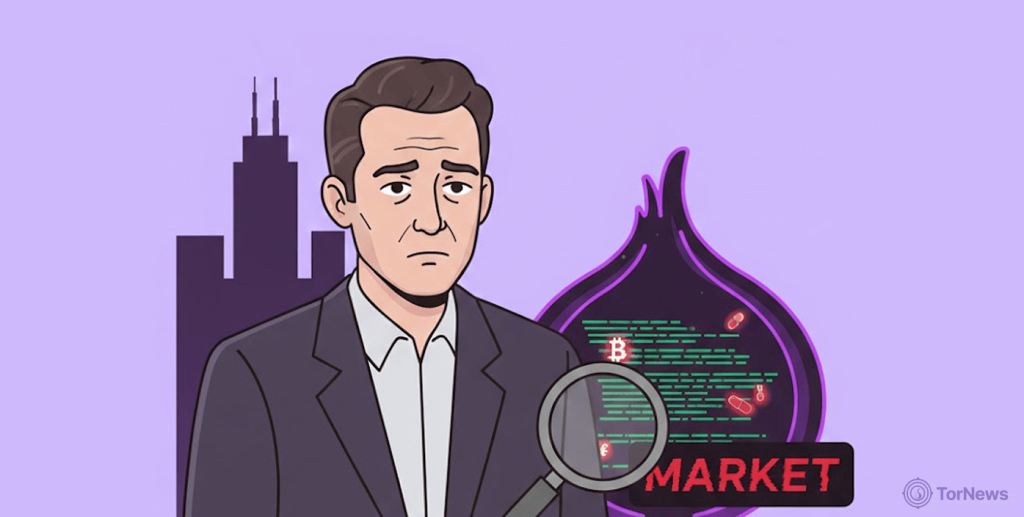
The dark web world witnessed another closure of one of its marketplaces and the downfall of a co-creator of a major underground market.
Through the efforts of the US law enforcement, a man linked to the illegal distribution of drugs has pleaded guilty during a court session.
Dark Web Marketplace Creator Pleads Guilty
30-year-old Rahiem Hamilton, a man from Suffolk, Virginia, has admitted guilt in Chicago’s federal court regarding his involvement in a dark web website, which authorities contend has sold drugs valued at approximately $375 million. He made this admission on Tuesday, at a Federal Court in Chicago, by acknowledging his operation of an illicit online market that distributed illegal narcotics to people worldwide.
In an ongoing effort to combat the widespread use of dark net sites to facilitate crime, federal authorities have undertaken a more aggressive approach to closing or limiting these markets, though the use of encrypted technology and cryptocurrency allows users to mask their identity.
Dark web markets, reachable only via applications such as Tor, serve as a criminal infrastructure for drug and arms trafficking and other serious crimes, including ransomware operations like the recent BlackCat case, where US cyber professionals pleaded guilty.
The guilty plea is a key step in the efforts of the U.S. Government to hold those responsible for operating these types of unauthorized online markets accountable.
Details of the Case and Charges
While several defendants appear in court documents, the Virginia man admitted to leading the operation of the defunct marketplace.
According to law enforcement, the marketplace was in operation for multiple years and attracted at least thousands of users to engage in buying and selling drugs illegally by using cryptocurrencies that allowed the buyer and seller to remain anonymous longer.
Court documents say Hamilton and Thomas Pavey, a 40-year-old from Ormond Beach, Florida, founded Empire Market, a dark web site that sold illegal drugs and other illicit goods between 2018 and 2020.
Prosecutors revealed that Empire Market facilitated over four million illegal transactions between sellers and buyers, amounting to over $430 million. As a result, analysts ranked the marketplace among the largest of its kind on the dark web during its operation.
The majority of the platforms operating within the dark web act like e-commerce companies, except they sell illegal drugs and contraband rather than selling legal products such as electronics, books, etc.
Silk Road, a now-shuttered online drug marketplace, became the first major dark web drug market in 2011 and handled about $449,000 a week in transactions before the FBI shut it down in 2013.
Authorities charged the defendant in this case with a federal conspiracy to distribute narcotics, carrying the possibility of a lengthy prison sentence if convicted.
According to the terms of his plea agreement, the defendant acknowledged that he was aware of the illegal nature of the marketplace and his efforts toward keeping it operational.
Further, the prosecutors stated that he provided technical support for the operations of the marketplace and managed the operations of the marketplace to maximize profit for the sale of narcotics while minimizing the risk of capture by law enforcement agencies.
During the court session, the defendant admitted his illegal actions and promised to assist the investigators. A reduction in sentence may happen if he cooperates with federal investigators, as he stated, and provides information on users, sellers, and participants in the marketplace. Sentencing will take place sometime in June this year.
The Endless Chase Between Law Enforcement and Dark Web Syndicates
Law enforcement has recently increased its operations to target online drug distribution cybercriminal infrastructure. There has recently been a rise globally in the number of international and U.S.-based agencies collaborating to shut down darknet markets and prosecute operators of those markets.
This follows a pattern of high-profile prosecutions, such as the recent case where a US man pleaded guilty to running a multi-state dark web drug ring.
However, these criminals are also becoming more technologically advanced and continuing to change the way that they conduct their business. As such, this situation has progressed into an ongoing “cat and mouse” game between law enforcement and criminal enterprises.
Some experts find dark web crime to be an enduring issue; just as when one marketplace is taken offline, another fills its place. For example, in the last decade, many clandestine sites such as AlphaBay and Incognito Market have been created and shut down in response to law enforcement activity, highlighting their ability to adapt and overcome enforcement efforts.
As the defendant’s guilty plea moves to sentencing, officials hope its repercussions will extend beyond the individual to send a clear message: anyone who builds or supports illegal drug markets online can expect to face serious consequences.
