-
Criminals are buying complete UK identity packs with ID scans and matching selfies for only $30-$35 on the dark web.
-
These identity kits are used with camera emulators to bypass biometric security checks at banks and fintech companies during sign-up.
-
AMLTRIX researchers warn this cheap, industrial-scale fraud links directly to everyday cybercrime like data breaches and phishing.
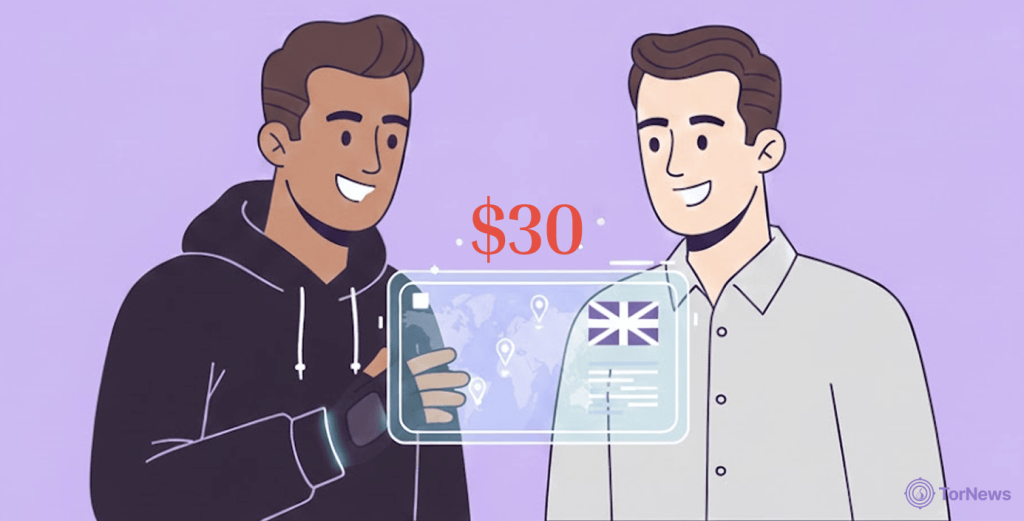
People face a scary new reality: a person’s digital identity is now a cheap commodity for sale. According to a recent study by AMLTRIX.com, an open-source, community-driven knowledge graph and framework designed to improve and standardize the fight against illicit finance and money laundering, criminals are buying and selling it to break into bank accounts. And it costs less than a nice dinner out.
The $30 Identity Theft Kit
New research reveals a booming dark web market. Analysts from AMLTRIX spent five days investigating 25 markets. They found a well-oiled business selling “full identity packages.”
For a mere $30 to $35 (the cost of a pizza), a criminal can get their hands on the full kit, which often comes with a high-quality ID scan, including the matching selfie that makes it usable and all the victim’s personal details.
“It’s now cheap enough to buy in bulk,” said Gabrielius Bilkštys of AMLTRIX. He says this shows how often personal data gets stolen and resold. The market has become fully industrialized.
Other nationalities are also for sale. U.S. identities are pricier at $45 to $100, with demand and victim profiles potentially influenced by the regions across the United States found to be most vulnerable to surging identity fraud. Russian, French, and Australian profiles are a bargain at $20 to $30.
How a Selfie Beats Bank Security
So, how does a static photo trick a high-tech liveliness check? The trick is infuriatingly simple. The criminals use a slick piece of software called a camera emulator (think a digital puppet master for your webcam).
Banks and apps use live video for “liveness” checks during signup, and the emulator tricks that system, then feeds the stolen, static photos into the bank’s video stream.
It makes the stolen selfie look like a real-time video. This easily bypasses the biometric check. A criminal can then open accounts in your name.
The same identity pack works across many services. They can open bank accounts, crypto wallets, and payment apps. The real victim often has no idea until debt collectors come calling.
From Data Breach to Bank Fraud
This dark web trade isn’t some rare, isolated danger—it’s a direct consequence of the everyday cybercrimes we see in the news.
Phishing emails, massive data leaks like the recent U.S. driver license data dump on the dark web, and stolen credentials feed these markets. Your information from an old breach might be in one of these $30 packs.
“Many organizations see the dark web as distant,” said Bilkštys. “In reality, it’s tightly connected to cases compliance teams deal with every day.”
The fallout explodes far beyond a fraudulent loan. These stolen identities often create “money mule” accounts that move dirty cash for other criminals.
This means an innocent person’s name gets tied to a money laundering investigation. A UN report confirms this pattern in organized fraud.
Verified Accounts Are a Gold Mine
For fraudsters who find the identity pack and camera emulator trick to be too much work, there’s a ‘concierge’ service. A basic UK identity pack is $30, but a preverified cryptocurrency account? That costs way higher, typically from $200 to $400.
Sellers who specialize in beating security checks do the hard work. They use the stolen data to open a real, verified account. Then they simply sell the login details.
This huge price jump is telling. It shows many lower-level criminals struggle with modern verification checks. They are willing to pay experts to do it for them.
AMLTRIX warns that some highly priced offers are likely scams. An ad for a physical UK passport might cost $2,600. But it could be a law enforcement trap or a ripoff.
How to Fight an Industrialized Threat
So what can be done? AMLTRIX says banks need a fundamental shift. Checking an ID at signup is no longer enough.
Financial institutions must watch what happens after an account opens. They should analyze behavior patterns, transaction history, and device data.
Does the account activity match the identity’s profile? A one-time check is weak against this industrial fraud. Continuous behavioral analysis is the needed fix.
The researchers will keep tracking these dark web patterns. Their goal is to build a better understanding of these money laundering methods. This fight requires adapting as fast as the criminals do, as seen in recent high-profile enforcement actions like the FBI’s seizure of a dark web domain tied to a $28M bank account hijacking scheme.
