The internet we use daily for browsing Google, social media, or news sites is just the surface web, a small fraction of the vast online world. Beneath it lies the deep web, a massive, unindexed layer that includes private databases, online banking, and password-protected sites.
Then comes the dark web. It is a small segment of the deep web, built on encrypted networks designed to provide anonymity and privacy. Although often linked to illegal activities, the dark web also serves legitimate purposes for journalists, activists, and users who value confidentiality.
If you’re curious about this hidden side of the internet, this article will guide you through the different types of dark web networks, their risks, the content they host, and practical safety tips to help you explore responsibly.
Types of Dark Web Networks
1. Tor (the Onion Router)
Tor is the most popular and widely used of the dark web networks. Its name derives from onion routing, which is a method that hides internet traffic in layers of encryption, and bounces the traffic through a series of servers, or “nodes,” operated by volunteers. This complicates attempts to trace the user’s IP address and identity.
How It Works
Tor protects your information from the outside world by wrapping it in multiple layers of encryption, just like an onion (and hence the name ‘The Onion Router,’ which is the full form of Tor). As your data travels through each node in the network, it peels away one layer of encryption until the final node sends a clear signal to its destination.
Common Uses
People use Tor to browse the web anonymously and to access special .onion sites you can only find on its network. It’s a vital tool for journalists, whistleblowers, and anyone who needs to communicate safely and privately.
Security
Tor offers strong anonymity, but there are some flaws. One of its weak points is the exit node. This is the final stop where your web traffic leaves the Tor network, and that last hop travels without encryption, potentially exposing details about your original connection.
Although Tor is very secure, it is not immune to security vulnerabilities, and if someone turns to it for malicious activities can understandably leave themselves vulnerable if other security authentication practices are not available (for example, use a VPN).
How to Access It
You can use the Tor network by downloading the official Tor Browser from their official website, which connects you to the Tor network automatically. Users can then access .onion domains directly by URL. For an added layer of security and to understand the trade-offs, many users combine Tor with a VPN. If you’re curious about the pros and cons of that setup, our ultimate comparison of Tor and VPN guide breaks it down in detail.
2. I2P (Invisible Internet Project)
I2P is similar to Tor, but it is an overlay network primarily for anonymous peer-to-peer (P2P) communication. It operates as a network within a network. Once you’re inside the I2P network, it routes your traffic internally with minimal delay (which makes activities within the ecosystem noticeably faster).
How It Works
I2P uses a “garlic routing.” Think of it as I2P’s version of Tor’s onion routing. But with a twist. Instead of a single message, it bundles multiple messages into one “garlic clove.” This makes it much harder for anyone watching to analyze the traffic and also helps the network run more efficiently.
Common Services
I2P is designed for secure messaging applications, decentralized personal blogs, and anonymous file sharing.
Security
If configured correctly, I2P is very secure for its intended usage, but it also takes a little more knowledge than Tor to use it securely.
How to Access It
Download and install the I2P software. The I2P software acts as a local proxy that routes traffic to the I2P network, so you will also need to configure your browser to use the proxy.
3. Freenet
Freenet is a decentralized, censorship-resistant network that aims for anonymous communication and file sharing. This is achieved by having users contribute part of their hard-drive space to a distributed data store.
The system takes a normal public file, chops it up, encrypts the pieces, and scatters them across the network. What that does is make it practically impossible to figure out who’s hosting the data or who asked for it.
How It Works
The design of Freenet is focused on disrupting censorship. Once data is indexed into the network, it is extremely difficult to remove.
Common Services
The network attracts many activists and researchers who share sensitive data, including political activism data and whistleblower documents.
Security
Freenet maintains anonymity by encrypting and relaying the data through multiple nodes in the network. The end user’s identity while hosting the file is never known by the downloader, and the downloader’s identity is also unknown to the end user.
How to Access It
Download and subsequently install Freenet’s client program. Once you’ve installed it, the client will automatically become part of the network. You can subsequently access the sites with the help of the integrated browser.
4. ZeroNet
ZeroNet is an innovative network that combines Bitcoin cryptography and BitTorrent-like peer-to-peer networking to create decentralized, server-free websites. These websites only exist on the computers of the users who host or visit them.
How It Works
Users visiting ZeroNet websites will also begin to host the site. When a user visits a site, it will now be hosted by that user, which will allow the site to be available without the original user (the person who initially visited the site and was hosting it).
Common Services
Like BitTorrent, a decentralized peer-to-peer protocol, you can update ZeroNet sites dynamically. They’re also tough to censor or take down with DDoS attacks because there’s no single server to target—the network has no central point of failure.
Security
ZeroNet security exists in its decentralization using cryptography. All sites are hosted by all the users in the network, making them resistant to censorship and not being exposed to attacks due to a single point of failure.
There is cryptographic technology like Bitcoin being used to secure content and users’ accounts, ensuring that people’s data is not tampered with.
How to Access It
Download and run the ZeroNet client, which creates a local server. Then, simply visit the ZeroNet site using your standard browser and access a ZeroNet site through the localhost address.
5. GNUnet
GNUnet is a peer-to-peer framework, designed to be a secure, self-organizing alternative to the legacy internet. It is perhaps the most complex and secure of these networks; GNUnet uses strong encryption and distributed hash tables (DHTs) to provide strong anonymity and privacy.
How It Works
GNUnet uses sophisticated routing methods to hide the sender and recipient of data, making it nearly impossible to surveil.
Common Services
GNUnet is enjoying popularity from privacy lovers, academics, and developers working on secure communication protocols.
Security
Strong encryption and its decentralized architecture offer a high level of security, as it is more difficult to surveil the network.
How to Access It
An interested user should download the GNUnet software suite. The installation may require utilizing the command-line; thus, users should refer to the official documentation for proper and secure setup.
How Dark Web Networks Differ: A Quick Look
The choice of network often depends on the user’s primary purpose. Here is a summary of the differences:
| Feature | Tor | I2P | Freenet | ZeroNet | GNUnet |
|---|---|---|---|---|---|
| Primary Use | Anonymous browsing on the clear web, hidden services | P2P communication, anonymous internal services | Censorship-resistant file sharing and communication | Decentralized, serverless websites | Secure, decentralized networking, research |
| Access Method | Tor Browser | I2P Router software | Freenet client software | ZeroNet client software | GNUnet software suite |
| Speed | Moderate | Faster for internal traffic | Slower due to distributed storage | Fast for small sites | Variable |
| Security Level | High with proper setup | High for internal comms | Robust for stored data | Moderate (lacks advanced encryption) | Very High |
| Popular with | Journalists, activists, and general users | Privacy advocates, tech-savvy users | Activists, researchers | Decentralization enthusiasts | Privacy researchers |
What are the Risks and Security Concerns for Each Dark Web Network?
As you may see, every dark web browser will have risks, and each can present unique security issues. They provide an abundance of privacy but are not as secure as you may expect.
1. Tor
The major risk with Tor comes from the exit nodes. When the last node sends out the traffic to its destination, it is no longer encrypted. Therefore, with no HTTPS protection, your data could be visible to others. Additionally, using an unconfigured or old browser can lead to a traffic leak of your IP address.
2. I2P
Because it is a smaller network, a targeted attacker with adequate resources may be able to disrupt your anonymity. Anonymity, if maintained at a high level, is a difficult task, and you will require a very firm grasp on the technical network of I2P.
3. Freenet
Freenet users can run the risk of unknowingly acting as administrators hosting illegal data on their hard drives, and this may get them into legal trouble.
4. ZeroNet
ZeroNet is peer-to-peer, which can present an IP address exposure, as well as the risk of downloading harmful content. Overall, ZeroNet is not as secure as Tor and does not provide the same anonymity that the Tor network can provide.
5. GNUnet
GNUnet is secure but complicated, and can lead to unintended security issues due to misconfiguration. Moreover, this newer project may still have bugs yet to be discovered.
Common Uses of the Dark Web

People use the dark web network for both legitimate and illegal activities. Below, we discussed some of the most common uses of the darknet:
- Accessing censored information: In many places, governments block social media sites, news sites, and even educational sources. Individuals use the dark web to bypass such regulations and join a free and unrestricted internet.
- Anonymous communication: If someone needs to communicate in a secure way, such as a journalist wanting to protect a source or a user wanting to avoid surveillance, the dark web has secure and private options for communications.
- Privacy from data collection: In a world where companies and governments track and create massive amounts of data, many people reach for the dark web in order to protect their privacy and exit the digital footprint left on the surface web.
Who Uses Different Dark Web Networks?
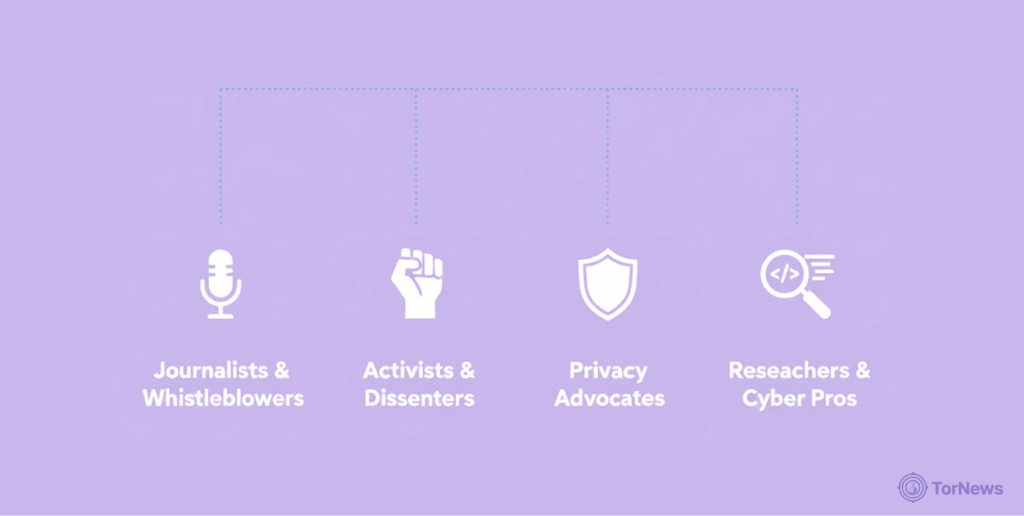
The people who use different Dark Web networks vary widely depending on their purpose. It’s not just cybercriminals and malicious actors. The primary users are:
- Reporters and whistleblowers: They make use of Tor to get information from different sources and publish sensitive materials without worrying about their privacy and the consequences of their actions.
- Advocates and political dissenters: Socio-docents who live in countries that censor content use these networks to organize their information, communicate with others, and share knowledge while still remaining hidden from the authorities.
- Privacy advocates: People who believe that the right to privacy is a human right use these networks to protect private data from corporations or governmental organizations.
- Researchers and cybersecurity professionals: They use networks such as GNUnet for research and new security protocol development.
Is It Illegal to Access the Dark Web?
It’s a popular myth that accessing the dark web is illegal. In most countries, the dark web’s legal status depends on what you do while there.
The dark web has a duality. On one hand, it is a playground for unlawful acts, including drug trafficking, cybercrime, and stolen data. Law enforcement agencies are working to observe and conduct operations in these sectors of the web to arrest the criminals.
That said, in an instance of needing to evade censorship and surveillance, the dark web is an exceptionally useful resource.
For instance, a journalist operating under a repressive government will utilize the dark web to privately speak with their sources. Activists will utilize the dark web to plan protests and spread information away from the government and in the dark.
In addition, many legitimate organizations, including Facebook (https://www.facebookwkhpilnemxj7asaniu7vnjjbiltxjqhye3mhbshg7kx5tfyd.onion/) and The New York Times (https://www.nytimesn7cgmftshazwhfgzm37qxb44r64ytbb2dj3x62d2lljsciiyd.onion/), host sites on the Tor network so people in high-censorship countries can access information without censorship.
On the other hand, there are several dark web forums and marketplaces available where cybercriminals sell drugs, stolen data, weapons, and perform many other illegal activities. And as you know, this is all illegal, and these people use the dark web for these illicit purposes just because it provides anonymity.
So, the dark web is a form of technology, just as any other form of technology. It is a tool, and in the case of the dark web, illegal or non-illegal use will depend upon your usage. If you don’t use it in a criminal act, you’re not acting unlawfully.
Types of Content and Services on the Dark Web
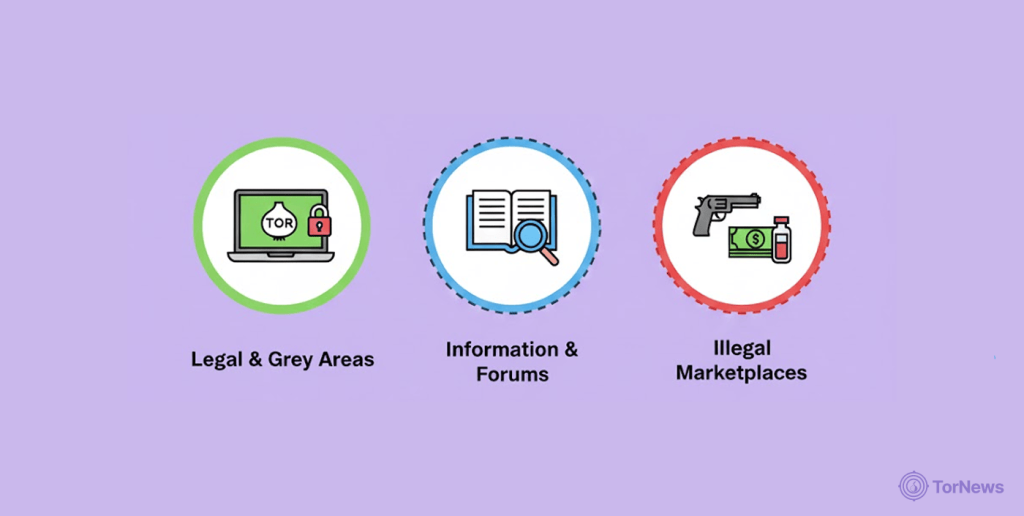
The offerings on the dark web vary widely. Although headlines typically focus on illegal activity, there is a wide range of content and services available:
- Illegal marketplaces: These may be the most recognizable site pages, where users participate in the purchase and sale of illegal goods and services, such as drugs, weapons, and hacked data, and may also do so anonymously with cryptocurrency.
- Hacking forums or hacking services: Cyber criminals use the dark web to sell hacking tools and services, as well as malware and personal data that has resulted from data breaches. They may also offer their hacking services for hire through the dark web.
- Whistleblower platforms: Safe platforms offer individuals a way to leak sensitive material they want to share with journalists and organizations, without a chance of any repercussions to their safety.
- Information dumps and leak sites: These sources host massive databases of stolen or leaked information, such as credit card numbers, personal credentials, etc.
- Forums and communities: The dark web has forums like the surface web, which can be related to any interest space, political affiliations, or hacking. Like before, many of these are private and require an invitation to enter.
- Search engines and directories: Regular search engines do not index the dark web, but there are specialized .onion search engines and directories that can help users uncover hidden services.
- Cryptocurrency services: Other services, like Bitcoin mixers and tumblers, are very popular to obscure the transaction history of cryptocurrencies used, which makes users anonymous.
How to Stay Safe from Dark Web Threats
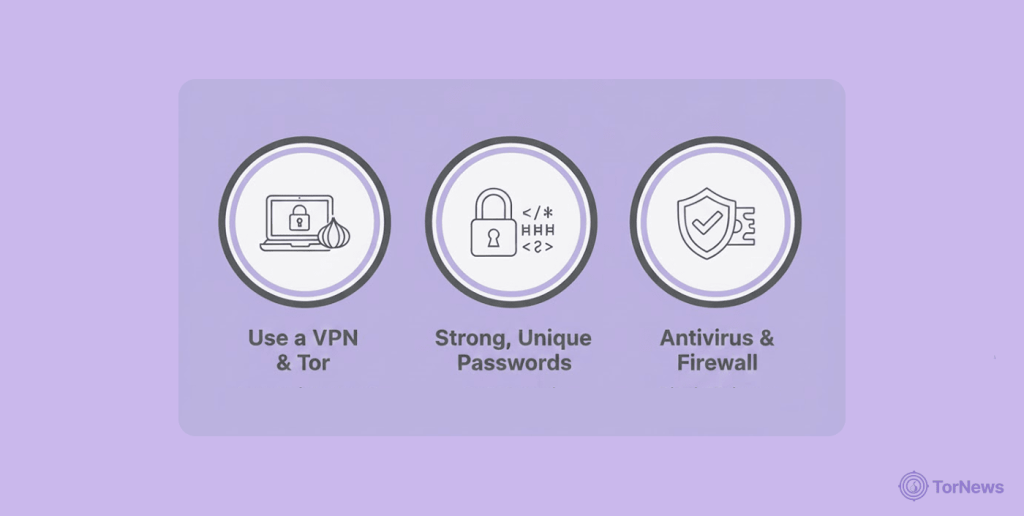
Due to the various risks that threaten Dark Web networks, you need to follow guidelines regarding your safety. While accessing the dark web is legal, the nature of the dark web is unregulated and filled with threats of all kinds, from malware to scams:
- Use legitimate tools: Utilize a trusted and verified dark web browser such as Tor Browser. It may also make sense to utilize a reputable Virtual Private Network (VPN) for an added layer of encryption and obfuscation of your Tor traffic from your Internet Service Provider (ISP).
- Never download: Do not download files from the dark web! Virtually every file is infected with a virus that will infect your computer and threaten your data.
- Never provide personal identifiable information: Don’t use your real name, email, or any personal identifying information on the dark web. Whatever information you provide that is linked to your identity is highly risky.
- Stay alert: Be careful about where you click. Phishing scams and malicious hyperlinks abound. Only visit sites you know to be safe and do not provide websites that seek personal information or payment.
- Update software: Keep your operating system, your web browser, and other security tools like a VPN or an antivirus updated.
- Use two devices: To ensure maximum security without changing the manner in which you use your normal behavior, use two computers or investigate the use of a live operating system like Tails to secure your activity.
Conclusion
The dark web is a complicated and frequently misunderstood aspect of the Internet with several distinct networks. It can serve as an important space for privacy and freedom of speech, but also an illegal activity and a risk-filled area.
By familiarizing yourself with the various networks, their purposes, and the important safety measures, you can unpack the dark web as a container for both anonymity and harm.
FAQs
The deep web does not receive any indexing from search engines, which can refer to any part of the internet. Examples of this could include online banking, email, and any sites you need to log in to. The dark web is a tiny, specific part of the deep web (a deep web with illegal activities) that is intentionally hidden and requires a special browser (i.e., Tor) to access.
The dark web is primarily all about anonymity and privacy. While many use it for illegal purposes, it was originally created for the military to store their communications in relative safety. The dark web has evolved into a place where you can escape surveillance and censorship.
It is never safe to purchase things on the dark web, and even legal items can bring a tremendous amount of risk. While legitimate sellers do exist, it’s safe to assume that you’re very likely getting scammed—either receiving counterfeit goods or having your payment information stolen.
Your information would get out on the dark web if a company you use gets hacked. Multiple cybersecurity companies provide dark web monitoring services that will search dark web sites and databases to find your credentials and alert you if they do.