-
The Linux version of LockBit 5.0 (LINUX Locker v1.01) contains built-in Curve25519 public keys that allow complete file encryption without any connection to command-and-control servers.
-
The malware actively evades analysis by detecting strace and inspecting /proc/ioports, while giving operators controls for partial encryption, free-space wiping, and self-deletion.
-
Because C2 blocking cannot halt execution, defenders must rely on behavioral endpoint controls that catch mass file modifications and unusual filesystem activity.
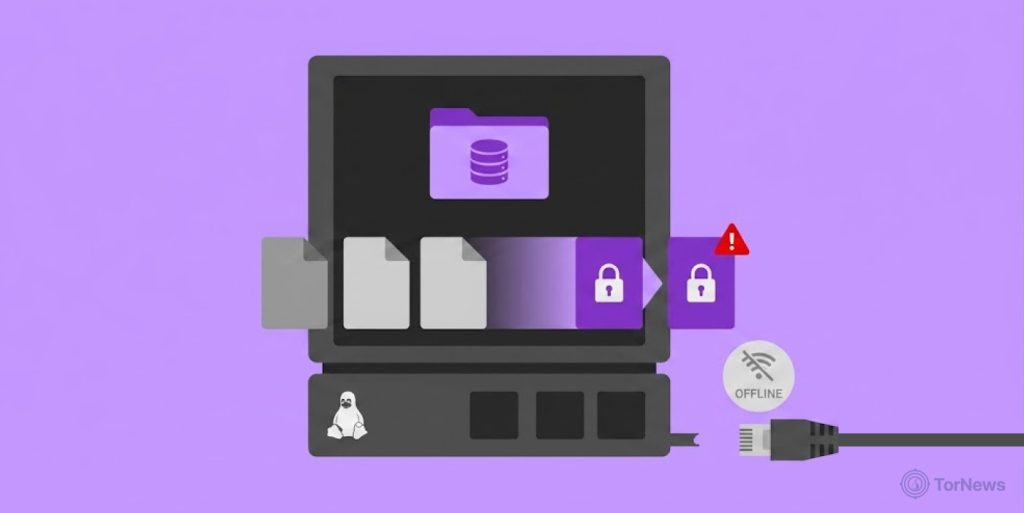
Security analysts at Netacoding recently published a detailed technical report covering an advanced Linux malware variant. The analyzed file belongs to the infamous LockBit 5.0 ransomware operation, specifically running as LINUX Locker v1.01.
Rigorous testing inside isolated research environments shows that the program can encrypt whole operating systems without sending or receiving data across external networks.
Traditional enterprise security setups rely heavily on catching suspicious network traffic to block digital attacks before major damage occurs. This offline-first Linux build bypasses those standard network boundaries completely during active file locking routines.
Computer emergency response teams must adjust their defensive focus to spot malicious actions directly on local Linux server endpoints.
Embedded Encryption Keys and Network Invisibility During File Locking
The analyzed malware employs a blend of ChaCha20/XChaCha20 symmetric ciphers along with Curve25519 asymmetric cryptography for obstructing the files of users.
Operators hardcode the Curve25519 public key of the attacker directly inside the compiled binary file; this design choice means the program does not need to connect with remote servers to request encryption keys. System keys remain protected inside the executable file from the moment execution starts on a compromised server.
During controlled testing inside isolated virtual machines, researchers recorded zero outbound or inbound network packets. The software processed entire file trees locally without contacting any command-and-control servers.
Standard network monitoring tools fail to flag this activity because the software remains completely silent on local networks. Security teams watching live firewalls will see no unusual data transfers during the attack.
In addition, the program optimally searches local file systems as it scans the connected file systems of the host computer. It employs parallel processing technology to carry out various encryption jobs all at once.
Through this mode of operation, the required time for file locking drops significantly, with system administrators having very limited time to intervene manually. This makes it possible to lock huge and several hard drives within a few minutes.
Hence, blocking IP addresses or domain names of the attackers will not help once the process starts. Some specialists note that the existence of offline encryption options makes firewalls ineffective during the execution process.
Local servers can lose access to critical files even when completely disconnected from public web infrastructure. It is important for companies to understand that isolating the network alone will not stop the local destruction of files.
Moreover, the malware systematically searches for attached network shares and external drives mounted on the host system. It treats every accessible mount point as a valid target for immediate encryption. The only way to minimize the risk in case of infection on the main computer is to unmount all the dormant drives.
Built-in Anti-Analysis Safeguards and Operator Configuration Choices
Besides offline file locking capabilities, the malware includes several stealthy mechanisms to evade detection by security tools. The binary actively detects debugging tools like strace to spot researchers analyzing its underlying code.
It also inspects system files like ‘/proc/ioports’ to identify virtual machine environments. Checking hardware ports helps the ransomware determine if it is running inside an analyst’s sandbox.
If the software spots an active debugging environment, it can alter its execution flow to confuse analysts. These anti-analysis features help the ransomware run quietly on production Linux servers without raising immediate alarms.
Malicious actors build these evasion tricks directly into the core code to maximize operational success. Evasion tactics force security researchers to spend extra time analyzing binary structures.
In addition, the threat operators use a variety of options for controlling the execution of malware via command-line parameters. For example, the attackers may decide the level of encryption from 10% to 90% on their targeted file content.
This technique of partial locking allows for shortening the execution time and still making valuable information from the company database unusable. Custom execution options give affiliates flexibility depending on their specific attack goals.
The operators may make use of free-space erasing functions that cancel out the possibility of restoring the deleted files. They may also choose to hide ransom notes or skip changing the file types to decrease the chances of detection.
However, operators can also toggle default self-deletion features depending on whether they want to wipe malware binaries post-infection. Wiping free disk space removes remnant file fragments from unallocated drive clusters.
Moreover, operators can run the software in silent background modes to avoid printing status logs to the terminal. Suppressing console output prevents system operators from noticing ongoing encryption tasks in active terminal windows. Hiding terminal activity makes silent background execution much harder to notice during routine server monitoring.
Recommended Defense Strategies for Securing Linux Enterprise Endpoints
Defenders must rethink traditional server security models when dealing with offline-capable ransomware strains. Relying purely on network boundary checks leaves enterprise Linux servers vulnerable to rapid data destruction.
The infrastructure that enables ransomware attacks, including the bulletproof hosting services used to deploy malware and host command-and-control servers, is increasingly being targeted by law enforcement. The U.S. recently offered a $10 million reward for information on Russian operators of bulletproof hosting services after a federal indictment.
Security teams need endpoint detection tools that monitor local process behaviors continuously. Behavioral monitoring helps spot malicious software before entire filesystems suffer irreversible damage.
Meanwhile, security alerts should trigger whenever untrusted applications perform rapid filesystem modifications across multiple directories. Detection engines must flag unusual reading or scanning of /proc directory files immediately.
Spotting sudden creations of ransom notes or batch file renames allows automated defenses to isolate infected processes. Early process termination prevents ransomware from finishing its full multithreaded encryption cycle.
Therefore, organizations should implement strict access controls across all production Linux servers and virtual hypervisors. Limiting administrative privileges prevents unauthorized applications from executing parallel file processes. Complying with the principle of least privilege ensures that low-grade service accounts do not initiate harmful malware programs, either.
Additionally, periodic security reviews help the admin staff detect any unpatched vulnerabilities in advance of a malicious attack on the server. The combination of monitoring of process behavior and strong backup policies constitutes a very effective defense against silent offline threats.
Moreover, organizations with good local endpoint protection capabilities can minimize breakdown of operations from an unexpected cyber threat. Also, preventive endpoint protection assures that critical applications remain safe against evolving malware strains.
